We inherit obligations to ancestors whose struggles and sacrifices made our existence possible; we bear duties to descendants whose world we are shaping by our choices; we are stewards, not owners, of an estate that must be passed on improved to posterity.
Modern political thought can trace its origins to a founding act of violence: the severing of earthly authority from any transcendent foundation. When the social contract theorists - Hobbes fleeing civil war, Locke justifying revolution, Rousseau fantasising utopia - reconceived political legitimacy as grounded in human agreement rather than divine prescription, they believed they were liberating humanity from superstition. What they actually accomplished was a form of metaphysical patricide: the destruction of the only grounds on which political authority can be distinguished from organised coercion.
The consequences for modernity are now inescapable. We inherit institutions - constitutional government, the rule of law, limited sovereignty, human dignity, the inviolability of conscience - that were forged over centuries within a synthesis of the Hebraic (biblical faith) and the Hellenic (classical reason), the twin engines of European civilisational achievement. Yet we have systematically dismantled the metaphysical foundations that made these institutions intelligible. We have cut off the fruits from the roots and keep the ethical superstructure whilst denying the theological infrastructure that alone renders it coherent. As the nineteenth-century Spanish reactionary Juan Donoso Cortés diagnosed with prophetic clarity, liberalism represents the transitional phase when society lives off the moral capital of Christian civilisation whilst no longer believing Christian dogma. That capital is nearly exhausted. The choice before us is not between progress and reaction, but between two fundamentally incompatible visions of human existence. At the heart of conservative political philosophy stands what might be called a quaternary of order: faith, family, flag, and freedom. These are not four separate principles to be defended independently but a unified architectonic structure, each element supporting and requiring the others in necessary sequence.
Faith represents the vertical axis, the grounding of all earthly authority in transcendent truth. Insofar as it is a pre-political posture, faith ensures that sovereignty is always limited, always answerable to a justice it did not create and cannot alter. Without this dimension, political authority teeters permanently at the edge of organised violence. Family represents the generative foundation, the primordial cell from which all political order grows, the school of virtue, the mechanism of cultural transmission across generations. More crucially, it is the first and most important school of freedom, where children learn obedience to legitimate authority, respect for others, and subordination of immediate desire to long-term good, capacities without which self-government is impossible. Flag represents the horizontal-temporal axis, the particular national community extended through time, binding the dead, the living, and the yet unborn. The nation is not an arbitrary social construct but the organically emerging necessary condition for genuine political community.
Finally, freedom represents the organising horizon towards which the other three dimensions oriented. Liberalism does not grasp what conservatism does, namely that the only freedom worth having is the freedom not to whatever one wants but rather the freedom to do what one ought to do. That means that freedom - properly understood - must be ranked beneath the first three foundational goods; only then can society achieve the most propitious conditions for what Burke called ‘ordered freedom.’ Yet contemporary discourse defines freedom negatively, as absence of constraint: I am free to the extent that nothing prevents me from doing whatever I want. This is the freedom of the unencumbered self, the autonomous individual who stands prior to all social bonds. It is the freedom promised by Rousseau’s Contrat Social, by Mill’s On Liberty, by Rawls’s theory of justice, the freedom that is wired into the fabric of liberal political theory.
But this negative freedom is not freedom at all. It is slavery: slavery to appetite, to passion, to the tyranny of the present moment detached from past wisdom or future consequence. True freedom - what the classical and Christian traditions understood as libertas - is the capacity to act in accordance with reason and virtue, to pursue genuine human goods rather than mere subjective preferences, to fulfil our nature as rational and social beings oriented towards truth and justice. This ordered freedom is not natural endowment but achieved capacity. It requires formation, discipline, habituation to virtue. It emerges only within structures of obligation we did not choose: the faith that grounds our understanding of human dignity and purpose, the family that forms our character before we possess capacity for autonomous choice, the nation that provides the cultural and institutional framework within which our freedom can be meaningfully exercised.
At the heart of conservative political philosophy stands what might be called a quaternary of order: faith, family, flag, and freedom.
This basic architecture of the politics of home is not cultural prejudice but discovered truth. It is not the mere preference of one civilisation among many, but the universal foundation without which genuinely human political life becomes impossible. The argument proceeds by excavating the deep structure of political order, moving from moorings in the transcendent (faith) through generative source (family) to particular instantiation in a moral community (flag), culminating in the proper understanding of freedom as achievement downstream of unchosen obligations.
Faith - A Mooring in Transcendence
The fundamental question of political philosophy can be stated simply enough: by what right does one man command another? Contemporary political theory, from Rawls’ original position to Habermas’ discourse ethics to various contractarian permutations, answers that authority derives from consent, from contract, from the rational agreement of autonomous individuals. That construal of authority appears liberating, yet it conceals a fatal contradiction. If authority ultimately rests on bare human agreement, then it possesses no binding force beyond transient equilibria of power. The social contract can be renegotiated whenever circumstances shift or democratic majorities change. Rights become mere positive grants, revocable at will; justice becomes whatever the sovereign declares it to be; and the distinction between legitimate government and tyranny disintegrates.
The classical world grasped this problem with admirable clarity. Cicero’s achievement in both De Legibus and De Re Publica was to articulate a vision of law as participation in eternal reason: ‘Law is the highest reason, implanted in Nature, which commands what ought to be done and forbids the opposite.’1 True law transcends positive enactment; it exists independently of human will, accessible to rational reflection, binding on all peoples at all times: ‘There will not be different laws at Rome and at Athens, or different laws now and in the future, but one eternal and unchangeable law will be valid for all nations and all times.’2 Roman jurisprudence could extend across diverse cultures precisely because it claimed to rest not on Roman custom but on natural principles intrinsic to nature itself.
And yet, in the end, Cicero could not answer the deepest question his philosophy of natural law provoked, which is that if nature is merely the realm of physical causation governed by necessity, if there exists no cosmic intelligence ordering all things to their proper ends, then why should this “highest reason” be binding? The “ought” cannot be derived from the “is” without smuggling in precisely the metaphysical commitments that natural law theory requires but cannot establish on its own terms. The Stoic solution that nature itself is divine and that the cosmos is rational order provides no ground for obligation unless that rationality is understood as the will and wisdom of a personal God who creates, sustains, and orders all things to their divinely appointed ends.
It was First Temple Judaism and, later, Christianity that remedied this theoretical deficit by providing what Cicero could not: genuine ground for natural law’s authority. The Hebrew scriptures understood from the beginning the imperative of grounding law in divine promise and command. The covenant at Sinai is not negotiation but command: ‘I am the LORD your God, who brought you out of the land of Egypt, out of the house of slavery. You shall have no other gods before me.’3 This is covenant, not contract. It is a relationship established by the superior party, creating obligations that precede and transcend individual consent. The Decalogue is not proposed for ratification by popular vote but revealed for obedience. Yet remarkably, this theocracy contains within itself the seeds of limited monarchy: the king himself is bound by Torah, required to copy the law with his own hand, prohibited from accumulating excessive wealth, wives, or military power. The prophets - Samuel, Nathan, Elijah, Isaiah - speak God’s judgment against royal tyranny that provides a meta-constitutional constraint avant la lettre. On this view, sovereignty belongs ultimately to God alone, and all human authority is delegated, conditional, revocable. The structure of the Decalogue itself instructs in political philosophy: the first tablet (duties to God) grounds the second (duties to neighbour). Why should I not murder, commit adultery, steal, bear false witness? Without the vertical dimension - without recognition that human beings bear the divine image and that justice reflects God’s character - these prohibitions become arbitrary social conventions.
When Thomas Aquinas in the Summa Theologiae declared that natural law is the rational creature’s participation in the eternal law, he was not merely adding theological ornamentation to Cicero’s jurisprudence. He was solving its fundamental problem. Eternal law was now explicitly understood as divine reason governing all creation, the providential wisdom of a personal God who orders the cosmos to its proper ends. Human positive law derives its binding force not from legislative will but from conformity to natural law, which participates in eternal law. This creates a hierarchy of eternal law, natural law, and human law according to which human legislation finds legitimacy only through ultimate participation in divine wisdom. The practical implications of this bear revolutionary ramifications for political philosophy. The sovereign can command only what natural law permits; beyond that boundary, his commands lack moral force and may justly be resisted. This is not theocracy inasmuch as it is not the direct rule of priests over temporal affairs, but something more subtle: the subordination of all earthly authority to transcendent justice. Political authority is real, derives from God, and generally merits obedience. But it is not absolute: it exists under judgment and it can be called to account by a law it did not make.
Without a transcendent theological foundation, freedom itself becomes unintelligible. Why should anyone possess rights that the state must respect? Why should individual conscience be inviolable? Why should there be limits to sovereign power? Liberal theory’s answers -because rational agents would so agree in the original position, because utility is maximised, because human dignity demands it - all smuggle in premises they cannot justify in the absence of the theological foundations they reject. Human dignity, inviolability of conscience, limits to power: all these make sense only if human beings bear divine image, if there exists a justice not of human making, if sovereignty ultimately belongs to God rather than to any earthly authority. Remove the theological foundations, and these principles become mere assertions, incapable of withstanding determined challenge from those who find them inconvenient.
Family - Where Freedom Is Formed
We have established that political authority must be grounded in transcendent truth. But this raises an immediate question: how does this transcendent truth shape human beings capable of living under ordered liberty? How do abstract principles become concrete dispositions? How does natural law written on the heart become habituated virtue capable of sustaining free institutions? The answer is that faith requires the concrete community of love to be incubated and passed on. Political community does not arise from isolated individuals in a state of nature agreeing to establish government. No such state ever existed and no such agreement ever occurred. Every human being begins life in a state of total dependence on a family, shaped by relationships he did not choose, inheriting obligations he never contracted, and formed by authorities to which he did not consent. The family is not one institution amongst others. It is the generative cell from which all political order grows, and, crucially, it is the first and most important school of freedom.
This claim will seem paradoxical to the sensibilities of contemporary liberalism, which holds that freedom consists precisely in the liberation from all unchosen obligations. But the paradox dissolves once we understand freedom properly. The child does not enter the world as a free agent or as a bundle of rights waiting to be exercised. He enters utterly helpless, driven by appetite, incapable of rational deliberation or moral judgment. His “freedom” at birth is merely potential, not actual, a capacity that must be cultivated through years of discipline, moral education, and gradual habituation to virtue.
Aristotle recognised this at the very beginning of the Politics: ‘The family is the association established by nature for the supply of men’s everyday wants.’4 Before citizenship, before political participation, before any exercise of freedom in the political sense, there must be the oikos, the household that provides not merely biological survival but moral formation. The family exists for reproduction, certainly, but more fundamentally for the raising and education of the next generation. Within this primary community, the child learns foundational capacities without which freedom is impossible: obedience to legitimate authority (the parent who knows more than the child and exercises authority for the child’s good), respect for others (siblings and elders whose needs must be considered alongside one’s own), subordination of immediate desire to long-term good (the discipline of delayed gratification), and fulfilment of obligation even when inconvenient (the unchosen duties that constitute family membership).
The father does not rule because his children contracted with him, since no child ever consented to his own begetting. He rules because God ordained that children require parental governance during their formation. This authority arises naturally and is not mediated by consent. And that is precisely what makes the family the proper school of freedom. The child who learns healthy respect for legitimate parental authority, who experiences authority exercised not as arbitrary caprice but as pastoral care oriented towards his flourishing, develops the capacity to recognise and submit to legitimate authority in political life. Conversely, the child who experiences only tyrannical arbitrariness or, worse, the complete dissolution of parental authority, will lack the moral foundations necessary for citizenship in a free society.
To endorse such a conception of the function of family is not to endorse tyranny. Filial piety does not require servile submission to the caprice of a father or mother. Authority exists for the sake of peace, which not merely absence of conflict but positive harmony in which each member fulfils his proper role and contributes to common flourishing. The father’s authority is not unlimited dominion, but pastoral care oriented towards the maturation and eventual independence of children. The good father prepares his children for freedom by forming them in virtue, transmitting not merely biological life but moral wisdom, cultural inheritance, and practical judgment. Tyranny is the corruption of this legitimate authority, not its essence—the father who rules by caprice, who exercises power for his own gratification rather than his children’s good, who demands servile obedience rather than cultivating mature judgment, has betrayed his paternal vocation. The first society is not the political community but the family, which exists to fulfil needs that isolated individuals cannot meet: procreation and child-rearing (the demographic foundation of any polity), economic production (the household economy as base of the national economy), the transmission of culture (children learn language, religion, morality primarily within the family), and the cultivation of virtue (pietas - reverence for parents and ancestors - is the root of all social virtue).
Crucially, the family provides the economic foundation for political liberty. In De Regno, Aquinas argues that a kingdom of independent householders, each secure in property and capable of providing for family needs, will maintain freedom, whilst a kingdom of propertyless dependents will succumb to tyranny. This echoes the insight of the brilliant and unjustly forgotten Sir John Fortescue, the fifteenth-century English jurist whose De Laudibus Legum Angliae would profoundly shape his nation’s constitutional thought, namely that it is economic independence that grounds political independence. The freeholder, secure in his possessions and dependent on no master’s favour, can resist tyranny, speak truth to power, and act as genuine citizen rather than servile subject. The man without property, by contrast, dependent on wages from distant employer or benefits from the state, cannot be truly free.
But the family’s role extends beyond economic provision to something even more fundamental for freedom: the transmission of cultural inheritance across generations. Through family, we receive not only biological life but cultural inheritance: language learned at mother’s knee, religious formation through family prayer, moral intuitions absorbed before we can articulate them, practical skills passed from parent to child through apprenticeship and example. This cultural transmission cannot be replaced by formal schooling. The school can build on foundations laid by family, but it cannot create those foundations ex nihilo. A child who comes to school already literate, morally formed, and culturally grounded will flourish; a child lacking these foundations will struggle no matter how strong the pedagogy.
As the great nineteenth-century French historian Fustel de Coulanges demonstrated in The Ancient City, in Classical Greece the connection between family, property, and cultural-religious transmission was explicit and institutionalised. The family was constituted by worship of ancestral gods: the maintenance of the sacred hearth fire, the performance of burial rites, the honour paid to the manes of dead ancestors. Marriage existed primarily to ensure continuity of worship by producing male heirs. The bride left her father’s household gods to worship her husband’s, a transition marked by elaborate religious ceremonies. Childlessness was a catastrophe not merely personally but religiously: without sons, the sacred fire would die, the ancestral rites would cease, and the dead would be abandoned. Property belonged to the family in perpetuity because the land contained ancestral tombs requiring perpetual worship. The paterfamilias was priest before he was a property-owner, and his authority was sacred before it was legal. De Coulange’s scholarship reveals that we moderns are attempting to maintain institutions, from private property to family autonomy and filial duty whose religious foundations we have destroyed. We preserve the forms whilst denying the substance and increasingly the forms themselves are collapsing as their inner logic ceases to be intelligible.
The family also creates diachronic duties flowing in both directions across generations: we honour ancestors by preserving and transmitting what they bequeathed us; we serve descendants by living as responsible stewards of family resources, reputation, and tradition. The individual exists as link in a chain, not as autonomous atom whose life begins at birth and ends at death. This intergenerational perspective provides the temporal horizon necessary for true statesmanship: politicians motivated only by the next election cannot make decisions requiring present sacrifice for long-term benefit; but the father thinking of his children’s inheritance can. Burke’s famous conception of a nation as a ‘partnership of the dead, the living, and the unborn’ is first experienced and learned within the family.
Without the family as school of virtue, freedom degenerates into licence. Individuals without any moral formation will rarely be capable of self-government. They will require extensive external control precisely because they lack internal governance. The paradox is that licence - the absence of restraint - produces not freedom but a different kind of slavery: slavery to demagoguery from those who promise to satisfy desires without limit. Ordered freedom emerges only from formation within structures of unchosen obligation. And that begins in the family.
Flag - Where Freedom Finds Its Home
If faith provides the transcendent foundation and family provides the generative formation in virtue, why are not enough? Why must there be a third dimension – that is, the particular national community, symbolised by the metonym of ‘flag’? The question is crucial because the entire trajectory of progressive politics for at least two centuries has aimed at transcending national particularity in favour of universal humanity, whether through international law, supranational institutions, or the gradual dissolution of borders in the name of human rights. The answer begins with a profound truth about freedom: it cannot exist in the abstract but only in concrete form, within particular communities that provide the institutional and cultural framework for its exercise. This is not a concession to human weakness but reflects the structure of human nature itself. We are not universal rational agents capable of exercising freedom anywhere, under any conditions, within any institutional framework. We are particular beings, existing in specific times and places, shaped by languages and customs we did not choose, capable of meaningful action only within communities that we know and that know us.
Why should this be so? Because freedom as capacity for self-government is not natural endowment but cultural achievement. It requires what Aristotle called hexis, a settled disposition towards right action, developed through long immersion in practices that shape character and habit. One cannot acquire this capacity by reading constitutional texts or memorising political theory. It requires participation in living traditions, apprenticeship to inherited forms, gradual formation within institutions that embody the accumulated wisdom of generations.
This is why Fortescue that England’s constitution is not made but discovered. It develops organically through immemorial custom ‘whereof the memory of man runneth not to the contrary’ (in the words of Sir William Blackstone). English law grows through precedent and practice, embedded in the collective experience of the nation, rather than being imposed by legislative fiat according to rational plan. This is what Michael Oakeshott would later call tradition as opposed to technique: knowledge embedded in practice, transmitted through participation and apprenticeship that is not reducible to explicit formulae or universal principles. Fortescue’s England possesses the ability for self-government precisely because that capacity has been cultivated through centuries of participation in juridical and parliamentary institutions. Liberty is an organic inheritance, not a universal blueprint. A people lacking this historical formation cannot simply adopt English institutions by constitutional borrowing, any more than a person can acquire a language by memorising its dictionary.
But the necessity of national community runs even deeper than institutional development. As we have seen, de Coulanges demonstrated that political order was inseparable from religion, and religion was inseparable from particular place. The household was constituted by worship of ancestral gods, centred on the sacred hearth fire. The city (civitas) emerged from the religious union (synoikismos) of families and clans (gentes) under common civic gods. Each city had its own protecting deities; citizenship was religious membership, which is why exile was punishment worse than death. Law was originally sacred law, and the magistrate was priest before judge. The nation provides not just institutional framework but moral framework, the shared understanding of what constitutes the good life and what makes existence meaningful rather than merely tolerable.
Edmund Burke, writing three centuries after Fortescue amidst the French Revolution’s opening acts, would provide the most complete philosophical articulation of the nation as moral community extended through time. Against the revolutionaries’ claim to begin history anew based on abstract ‘rights of man,’ constructing political order on rational principles accessible to all humans regardless of historical circumstance, Burke insisted in his Reflections on the Revolution in France that the nation is a moral entity transcending any single generation. We inherit obligations to ancestors whose struggles and sacrifices made our existence possible; we bear duties to descendants whose world we are shaping by our choices; we are stewards, not owners, of an estate that must be passed on improved to posterity. This extension over time is essential for freedom. The individual who understands himself as a solitary subject, whose existence begins at birth and ends at death, who owes nothing to past and bears no responsibility for future, cannot exercise genuine freedom. He lacks the temporal horizon necessary for meaningful choice. His freedom reduces to present appetite-satisfaction, the tyranny of the immediate. But the individual who understands himself as inheritor and transmitter, who receives cultural and institutional inheritance from ancestors and bears duty to pass it on improved to descendants, possesses the temporal depth necessary for genuine freedom. He can make choices requiring present sacrifice for long-term benefit. He can subordinate immediate desire to enduring goods. He can participate in projects such constitutional maintenance, cultural transmission, and institutional preservation whose completion will outlive him.
‘Prescription’ is Burke’s preferred term for this diachronic legitimacy: constitutional arrangements that have persisted for generations, surviving the test of changing circumstances and scrutiny of successive generations, carry the presumption of wisdom. They embody the accumulated experience of countless individuals and communities facing the perennial challenges of human existence. This does not mean it is unchangeable: prescription is a defeasible presumption. But it does place the burden of proof on innovation: the reformer must demonstrate not merely that current arrangements are imperfect (everything human is imperfect), but that they have become intolerable and that his proposed remedy will not cause greater evils than it cures. Moreover, even justified reforms should be undertaken gradually, preserving as much of existing structure as possible, because institutions form organic wholes in which elements are interdependent in ways not always visible to rational analysis. Revolutionary change involving the wholesale destruction of inherited institutions to remake society according to an abstract plan is not bold progress but reckless vandalism.
Burke also understood the importance of organic communities mediating between individual and abstraction: ‘To be attached to the subdivision, to love the little platoon we belong to in society, is the first principle (the germ as it were) of public affections. It is the first link in the series by which we proceed towards a love to our country, and to mankind.’5 We do not begin with universal benevolence towards humanity in the abstract and then extend this systematically to particular persons. Human psychology does not work that way. We begin with love of those nearest us - parents, siblings, friends - and this particular love gradually extends concentrically outward to neighbourhood, parish, county, and nation. The cosmopolitan who claims to love all humanity equally whilst despising his own family and people is not a moral hero but a psychological impossibility. We can only love what we actually know; and we can only know what we encounter in concrete experience.
The choice lies before us: the patient cultivation of conditions for human flourishing, or the continued dismantling of everything that makes such flourishing possible. For us moderns, it is either homecoming or homelessness. There is no third way.
The nation is the largest community that can still command such knowledge and therefore such love. It is large enough for cultural achievement and effective defence but small enough for mutual recognition and genuine solidarity. Beyond the nation lies either empire, which imposes uniformity by force and destroys local particularities, or abstract humanity, which commands no one’s actual loyalty and provides no basis for mutual obligation. Yet the necessity of national particularity does not contradict but rather instantiates the universality of natural law and divine justice. Just as universal human nature requires particular languages for its expression, so universal natural law requires particular national communities for its emergence. The English constitution embodies the patient discovery through centuries of forms consonant with both divinely sanctioned natural law and the particular genius of the English people. It is neither pure divine decree nor arbitrary human construction but the gradual unfolding of political order that participates in transcendent justice whilst respecting human agency and historical particularity. Universal truth does not obliterate but rather fulfils genuine particularity, just as divine justice does not abolish but perfects natural human goods.
Freedom, then, is a national achievement, not a universal endowment. Different nations cultivate different forms of liberty, shaped by their particular histories, institutions, and moral traditions. English constitutional liberty is not identical to American republican liberty, which differs from Swiss confederal liberty. Each is genuine freedom, but each is particular, rooted in specific institutional developments and specific historical experiences. The attempt to export freedom as a universal template, divorced from the particular conditions that make it possible, produces not liberty but chaos. This has been amply demonstrated by the failed attempts to transplant Western democratic institutions to societies lacking the cultural preconditions, from post-colonial Africa to post-invasion Iraq and post-Soviet Russia.
Ordered Freedom
We have now established three foundations: faith as transcendent ground of authority, family as the generative source of moral formation, and ‘flag’ as a flesh-and-blood community that encompasses a civic and cultural landscape. We are now in a position to address directly what freedom is and why it must exist downstream of the first three foundations rather than constituting their starting point. For the entire edifice of modern political thought rests on a fundamental inversion: it begins with freedom understood as natural endowment, as pre-political capacity possessed by individuals in the state of nature, which political society then threatens to constrain. The purpose of politics, in this view, is to protect natural liberty against encroachment and to maintain the largest possible sphere of individual autonomy consistent with similar liberty for others. This is the freedom of Hobbes’s sovereign-creating individuals escaping the state of nature, of Locke’s property-owning citizens consenting to government, of Rousseau’s general will expressing collective autonomy, of Kant’s rational agents legislating universal law, of Mill’s harm principle delimiting legitimate interference, and of Rawls’s original position generating principles of justice.
This conception is plainly mistaken. Freedom is not a natural endowment but an achieved capacity. It is not an arche but a telos, not what we possess by nature but what we become through formation. Far from being threatened by faith, family, and flag, freedom is made possible by them. To understand why, we must distinguish between two fundamentally different conceptions of freedom, a distinction with roots in ancient philosophy but systematically obscured by modern political theory. The first is negative or arbitrary freedom, which understands liberty as absence of constraint: I am free to the extent that nothing prevents me from doing whatever I want. This is the freedom of the unencumbered self, the autonomous individual who stands prior to all social bonds and chooses which commitments to assume. It is freedom as spontaneity, as will unbound by external determination, as capacity for arbitrary choice unconstrained by inherited obligation or transcendent truth.
The second is positive or ordered freedom understands liberty as the capacity to act in accordance with reason and virtue, to pursue genuine human goods rather than mere subjective preferences, to fulfil our nature as rational and social beings oriented towards truth and justice. This is freedom as self-mastery rather than self-assertion, freedom as rational government of appetite rather than appetite’s gratification, freedom as capacity for genuinely human flourishing rather than mere absence of external constraint. It is the freedom described by Aristotle in the Nicomachean Ethics, by Cicero in De Officiis, by Augustine in De Libero Arbitrio, by Aquinas in his treatment of liberum arbitrium, by the entire classical and Christian tradition.
These are not merely different emphases or complementary aspects of a unified concept. They are fundamentally incompatible understandings. And the difference between them is the difference between civilisation and barbarism, between sustainable political order and inevitable descent into tyranny. Consider a simple example: the addict who acts on his craving for his drug of choice. He does what he wants. No external authority prevents his action. He possesses negative freedom in the fullest sense: his will is unconstrained, his choice is voluntary, his action is unimpeded. Yet he is enslaved. His ‘wanting’ is itself determined by chemical dependency, not by rational deliberation about genuine goods. He cannot not want the drug; he cannot deliberate effectively about whether satisfying this want conduces to his flourishing; he cannot subordinate this immediate craving to long-term goods. He possesses negative freedom (absence of external constraint) but utterly lacks positive freedom (capacity to act in accordance with his own rational judgment about what is truly good for him).
Now consider the opposite case: the virtuous person who routinely subordinates immediate appetite to long-term good, who fulfils obligations even when inconvenient, who contributes to common goods even when private benefit would suggest defection, who resists temptations that would provide immediate pleasure but undermine genuine flourishing. This person appears constrained by duty and limited by obligation. His will is not spontaneous but disciplined, his choices are not arbitrary but governed by reason, his actions are not unconstrained but directed towards genuinely good ends. Yet he is genuinely free: he possesses self-mastery, the capacity to act in accordance with reason rather than passion, the ability to pursue genuine goods rather than apparent goods, the power to govern himself rather than being governed by appetite.
The crucial point is that this second freedom - ordered freedom, true freedom - is not natural endowment. An infant possesses neither. The child is driven by appetite and cannot deliberate effectively about genuine goods. The transformation from infant to free person requires formation: years of parental authority, discipline, moral education, habituation to virtue. And this formation occurs through faith, family, and flag. Faith provides the framework of meaning within which freedom finds its purpose and direction. Why should I subordinate appetite to reason? Why pursue virtue rather than pleasure? Why fulfil obligations that inconvenience me? Why contribute to common goods when I could free-ride? Without transcendent foundation, these questions have no answer beyond subjective preference or arbitrary social convention. But faith reveals that human beings bear divine image, that we are oriented by nature towards truth and goodness, that our flourishing consists in rational and moral activity rather than mere appetite-satisfaction, that we are created for communion with God and neighbour rather than atomised self-seeking. Faith does not constrain freedom but orients it towards genuine goods, preventing the degradation of freedom into licence.
Family provides the primary formation without which freedom is impossible. The child is not born free. He is born helpless, driven by appetite, incapable of rational deliberation or moral judgment. His transformation into a free person—a person capable of self-government—requires years of parental authority, discipline, moral education. The child must learn obedience before he can properly exercise autonomy. He must internalise virtue before he can reliably choose virtuously. He must habituate himself to self-control before he can govern himself. This formation occurs primarily in the family. The good parent does not simply constrain the child’s natural freedom (the child possesses no such freedom to constrain) but cultivates the capacity for freedom that does not yet exist.
Flag (the national community) provides the institutional and cultural conditions within which freedom can be exercised. Freedom is not exercised in a vacuum but within particular legal frameworks, political institutions, cultural expectations. The English freeman’s liberty to own property securely depends on English constitutional protections developed over centuries. The American citizen’s freedom of speech depends on First Amendment protections and cultural norms supporting robust public discourse. These are not natural endowments but historical achievements, maintained across generations through particular national communities. Remove the individual from this framework and his freedom vanishes, regardless of his internal virtue.
Thus freedom emerges only downstream of unchosen obligations. The individual does not choose to be born, does not choose his parents or his nation, does not choose the language he speaks or the cultural inheritance he receives. These are givens, constraints, limitations on pure autonomy. But they are not obstacles to freedom. They are its preconditions. The attempt to construct freedom upstream of these obligations produces not greater liberty but its opposite. Consider what happens when we attempt this inversion. The emancipated liberal individual, unbound by religious authority, family obligation, or national loyalty, appears to be maximally free. He has escaped all unchosen constraints, all inherited obligations, all transcendent claims on his will. He stands as pure autonomous agent, sovereign over his own life, creating his own values, defining his own identity. This is the promise of negative freedom taken to its logical conclusion: the unencumbered self of liberal theory.
But observe the reality: such individuals are not powerful but paralysed, not self-governing but ungoverned, not free but adrift. They lack the moral formation necessary for self-mastery (the family having been dissolved or rendered optional). They lack the cultural resources necessary for meaningful choice (the national community having been dismissed as arbitrary constraint). They lack the transcendent orientation necessary to distinguish genuine goods from mere apparent goods (faith having been rejected as superstition). Their freedom degenerates into anxious self-creation, endless pursuit of experiences that fail to satisfy, vulnerability to demagoguery from those promising meaning and purpose, and ultimately dependence on extensive state management of their chaotic lives.
Moreover, societies composed of such individuals cannot sustain freedom. Self-government, whether personal or collective, requires virtue. It requires citizens capable of subordinating passion to reason, immediate gratification to long-term good, private interest to common welfare. But these capacities are not natural. They must be cultivated through formation in faith, family, and flag. A society that treats these as optional constraints on natural liberty rather than necessary conditions for its development will produce citizens incapable of self-government. Such citizens will require extensive external control precisely because they lack internal governance. The paradox, then, is that negative freedom risks provoking the tyranny it claims to prevent. People incapable of self-mastery must be mastered by others. The dissolution of faith, family, and flag does not liberate but rather requires an ever-expanding administrative state to manage the chaos produced by millions of atomised individuals lacking the internal governance that these institutions once provided. This is precisely what we observe in late-modern Western societies: the simultaneous celebration of individual autonomy and the metastatic growth of bureaucratic control over ever-more-detailed aspects of life.
Thomas Aquinas articulated the proper understanding in his treatment of law and governance in the Summa Theologiae. Human law must promote virtue, not merely coordinate wills or prevent obvious harms. The purpose of political community is not to maximise negative freedom but to secure the common good, the conditions enabling all citizens to pursue their proper end, which includes development of virtue and capacity for genuine flourishing. This requires far more than protection of individual autonomy. Aquinas also articulated the principle of prudence as the master political virtue. Prudence is not mere cleverness or expedient calculation but requires both understanding of universal principles (what Aquinas calls synderesis or the habit of first practical principles) and accumulated experience enabling application of those principles to complex, changing situations. The prudent statesman knows both natural law and his nation’s character, both universal human nature and his people’s particular genius, both timeless moral truths and the contingent circumstances of his historical moment. This is why Oakeshott’s distinction between technique and tradition is so crucial: political wisdom cannot be reduced to technique - to explicit formulae or universal algorithms - because it consists largely of traditional knowledge embedded in practice and transmitted through participation.
Conclusion - Homecoming or Homelessness?
We stand at a civilisational crossroads. The crisis we face is not primarily economic, though our economic dysfunction is pervasive and real. Nor is it primarily political, though political institutions are failing. It is fundamentally spiritual: we have attempted to maintain our inherited moral intuitions - the equal dignity of persons, universal human rights, compassion for the weak, progress towards justice - whilst abandoning the metaphysical foundations that alone once rendered these intuitions coherent. This impasse cannot continue indefinitely. Either we recover the foundations, or the superstructure will collapse.
The choice before us is not between progress and reaction but between two fundamentally incompatible visions of human existence. On one side stands the liberal-progressive vision: man as autonomous individual, politics as technique for coordinating individual preferences, society as aggregate of rights-bearing atoms pursuing self-defined goods, history as linear progress from superstition towards enlightenment, the future as realm of unlimited possibility unconstrained by past. This vision promises liberation but delivers atomisation, isolated individuals facing distant, unresponsive bureaucracies, lacking the solidarities and local knowledge that make political participation meaningful, incapable of genuine dwelling because severed from the sources of meaning that transcend individual will. Most critically, it promises freedom but produces its opposite: people incapable of self-government who therefore require extensive external control, the simultaneous celebration of autonomy and metastatic growth of administrative power.
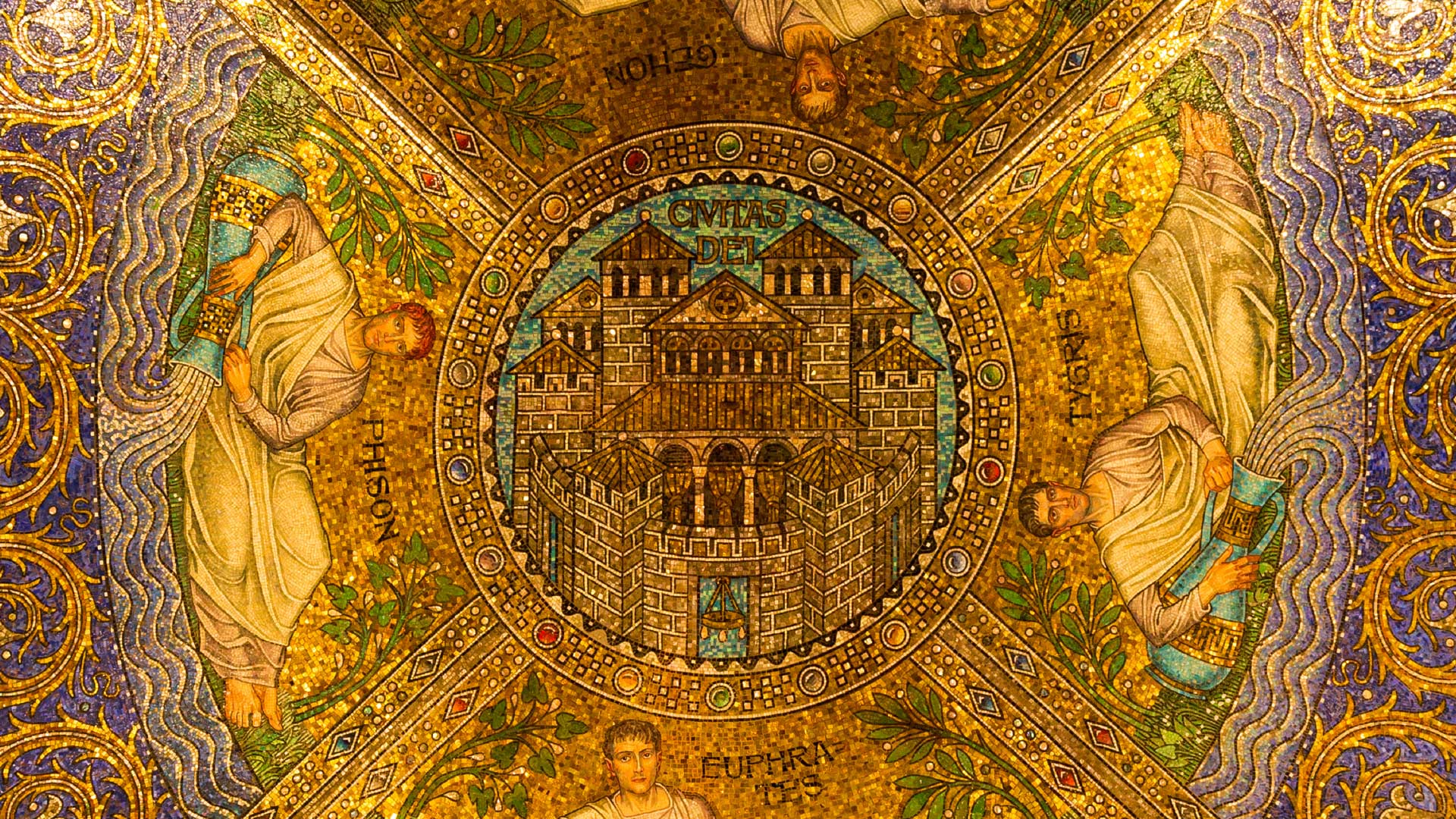
On the other side stands the conservative vision articulated in this essay does not promise utopia: conservatives know that, as Augustine taught, the City of Man (civitas terrena) cannot become the City of God (civitas Dei) through human effort. But it offers something more valuable than utopian fantasy, namely the possibility of genuine dwelling, of – as Martin Heidegger famously put it – being-at-home-in-the-world (In-der-Welt-Sein), and of inhabiting a meaningful order that connects present to past and future. Most critically, it offers genuine freedom, not the licence that degenerates into slavery but the ordered liberty that emerges through formation in faith, family, and flag. The conservative task is to preserve and transmit the conditions that make such dwelling possible: roots deep in sacred soil, connecting present to past and future; loyalty to the dead who bequeathed us civilisation and to the unborn who will inherit our choices; love for the particular that opens onto the universal, for we can grasp transcendent truth only through concrete instantiation, can love humanity only by loving these particular persons, can serve the common good only within this particular community. This is not reaction but renewal. The perennial wisdom that each generation must rediscover if human life is to remain human, if politics is to serve human flourishing rather than abstract ideologies, if we are to dwell poetically upon the earth rather than merely exist in bureaucratic administered zones.
The recovery of these four foundations, properly construed as an interwoven architectonic structure rather than separate principles, is not atavistic longing for a past that never was, but a restoration of permanent things. These are realities corresponding to unchanging human nature, without which no civilisation can in the end survive and without which human life becomes a homeless existence. The choice lies before us: the patient cultivation of conditions for human flourishing, or the continued dismantling of everything that makes such flourishing possible. For us moderns, it is either homecoming or homelessness. There is no third way.
1 Cicero, De Legibus, Book 1.6: ‘Lex est ratio summa, insita in natura, quae iubet ea quae facienda sunt, prohibetque contraria.’
2 Cicero, De Re Publica, 3.22: ‘[N]ec erit alia lex Romae, alia Athenis, alia nunc, alia posthac, sed et omnes gentes et omni tempore una lex et sempiterna et immutabilis continebit.’
3 Exodus 20:2.
4 Aristotle, Politics, 1.2.
5 Edmund Burke, Reflections on the Revolution in France, ed. Frank M. Turner (New Haven, CO: Yale University Press, 2003), p. 40.