
One might say that European society has always been much closer to American society than to Chinese society, which is obvious, and the reason is called the West.
10 September 2025 is one of those dates when, as a television viewer, you find yourself watching an important, extremely important news story, much talked about by everyone, but without realising that what you are witnessing may one day, in the future, be considered a historical event, one that future generations will read about in their school textbooks. None of us had any doubts on the morning of 11 September 2001 when the attack on the Twin Towers marked the official beginning of the era of conflict between Islam and the West. In reality, it was a conflict that, although more subtle and less talked about in public opinion, had already been going on for some years, but on that day in New York, Osama Bin Laden decided to certify it and reveal it to the world.
The day we saw the images of Charlie Kirk breathing his last breaths after being shot in the neck by a political opponent was a shock to everyone. We all immediately rushed to the media, both traditional and social, to comment on it. Looking at the reactions that all of us – politicians, journalists, opinion makers, citizens – in Europe had and the debate that arose around this crime on our continent, one observation stands out: the tone and violence of the confrontation between the European right and left was more or less equivalent to that seen in the United States. In fact, in the hours following the assassination, one only had to scroll through the homepage of the most political of social networks, X, where the algorithm favours the mixing of posts by American and European users, to realise how similar and overlapping they were.
But how is it possible that an event, albeit a brutal and shocking one, that takes place in the United States can have such a direct, violent and lasting impact in Europe? Because, and this is the subtlety I am trying to get across, Charlie Kirk’s murder was perceived by all of us Europeans as a domestic news story, not a foreign one. This is despite the fact that the scene was thousands of kilometres away from Europe’s western border, roughly the same distance that separates our eastern border from China. Yet, as we all know, the murder of a Chinese Charlie Kirk would have provoked much less of a reaction, even today when the shadow of Beijing covers our skies and its presence is becoming increasingly visible and tangible.
Of course, one might say that European society has always been much closer to American society than to Chinese society, which is obvious, and the reason is called the West. But with the Kirk episode, there has been a qualitative leap in this relationship: there is proof that the political life of the two sides of the Atlantic is moving towards a gradual merger. But just as 11 September was not the beginning but the culmination of the clash between Western and Islamic civilisation, 10 September is not the beginning but the culmination of this process. The internationalisation of politics, at least within the Western world, is not in fact a new phenomenon but one that has been going on for some time.
As we know, the first attempts at transnational action were made in the 19th century by workers’ movements, which later developed into the Marxist-inspired idea of proletarian internationalism. The idea developed by Marx and Engels is an intelligent one: labour is a driving force for political struggle capable of crossing national borders, and therefore perfect for promoting the establishment of an International, which is indeed what happened. For the two German philosophers, this was a natural and obvious reaction to capitalism’s destruction of national borders, since ‘the need for ever-expanding markets drives the bourgeoisie to invade the entire globe. It must establish itself everywhere, settle everywhere, create relations everywhere’. However, they did not hesitate to point to national borders as tools used by the bourgeoisie to hinder the class struggle, preventing workers from uniting as a single phalanx. This is why the socialist revolution had to be international.
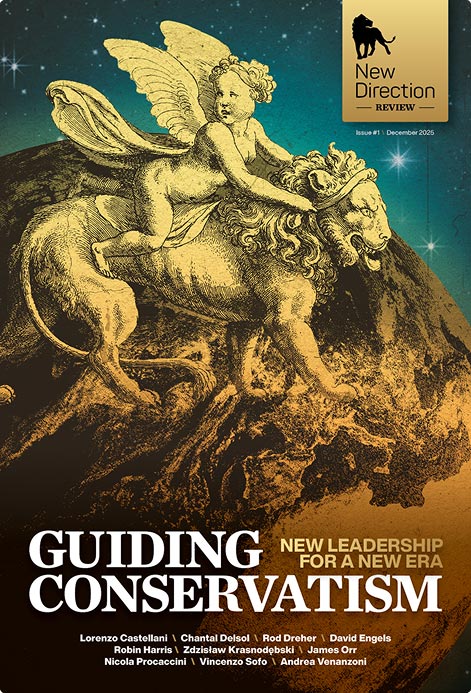
Regardless of the fears of the left or the exaltations of the right, it is a lion that must be understood how to ride.
After the end of the Second World War, however, the beginning of the Cold War created a schism between the left, divided between those loyal to the Western bloc and those loyal to the Soviet bloc, and the new socialist international limited itself to incorporating the former while excluding the latter: the ideological/geopolitical border prevailed over the global nature of the struggle they were supposed to be waging, but the desire to break down national barriers remained constant. We thus witnessed the birth of the social democratic international, the starting point for today’s global left. Meanwhile, the end of the First World War had sown the political seeds of political globalisation, the first fruit of which was the birth of the League of Nations as an attempt to provide global governance for the world, and the second was the establishment of the UN. A different concept of ‘internationalisation’ began to take shape, one that focused more on overcoming national borders through new supranational institutions than on global class struggle, a terrain where socialism and capitalism intersect, with the latter gradually managing to penetrate and mould the former, causing it to change and evolve into a more digestible form of progressivism.
The acceleration came with the fall of the Berlin Wall and, therefore, the end of the Cold War: with the border of borders shattered, economic globalisation began to proceed at a brisk pace, raising one international support organisation after another (IMF, WTO, World Bank, etc.). The model that this phenomenon brings with it, the liberal and free-market model, is ultimately appealing to the left, and so – silently – the traditional class struggle with the proletarian worker as its protagonist disappears from the agenda. What remains is the war on national borders, but there is a big problem: finding a way not to deny one’s socialist nature. And two variations: not being able to define oneself as either liberal or free-market and having to find a way to continue, or pretend to do so, to stand up as champions of class struggle. Thus arose the liberal left*, with ad hoc censorship of the final part of the word so as not to tell the whole truth. And so many small class struggles arise, some exploited, others invented from scratch: those in favour of the global south, those in favour of migrants, those in favour of the climate, those in favour of the LGBTQ world. From the socialist international to progressive anti-globalisation.
If there is one thing that must be acknowledged about the left, it is that they have been able to ride the global wave, tailoring their methodology of action to suit. Campaigns such as those on climate catastrophe or minority rights have allowed them to exploit the process of globalisation to spread and impose their new ideology across the globe, or at least in the Western world. Throughout this time, however, if there is one thing that must be blamed on the right, it is that it has failed to develop a counter-action at the same time. In their defence, it must be said that the very fact of being engaged in the defence of national entities (and the borders that these entail) constituted an understandable conceptual obstacle to the organisation of transnational political action, which at that stage might have seemed a contradiction in terms. To find a principle of transnational organisation of the struggle on the right, we must therefore wait for the new millennium and the growth of the influence of European institutions on the political, economic and social dynamics of its Member States and, with it, the increase in the importance of Community political forums. But also the acceleration of the political agenda set up by US progressives and handed over to their overseas allies.
It is in fact thanks to Brussels, the cold meeting place for delegations from all the continent’s parties, which has evolved to embody the role of common enemy, that the right wings of the various European countries are beginning to talk and reason with each other. But it is thanks to Washington, or rather thanks to the radicalisation of the confrontation sought and provoked by American progressives and then imported by their European counterparts, that the two right-wing factions separated by the Atlantic are beginning to come together. This has caused an earthquake: the birth of conservative anti-globalism. Conservatism is the glue, the only possible glue, generated in the US but restoring traditional European values.
The assassination of Charlie Kirk is not the beginning but the culmination of this rapprochement. And it is probably the point of no return in the process of internationalising the political battle within the West, made official by progressives raising George Floyd as their transnational banner, thinking they had a contemporary martyr who would give them undisputed moral superiority, not imagining that in doing so they would themselves provoke the birth of a true martyr in the opposing camp. The conservative tsunami caused by the earthquake described above will most likely be the protagonist of European and Western dynamics in the coming years. It is the geopolitical scenario itself that favours it, or rather demands it. What we will do in this issue is provide you with the elements to analyse the nature, features, usefulness and concrete applicability of a phenomenon that is probably inevitable. Regardless of the fears of the left or the exaltations of the right, it is a lion that must be understood how to ride.