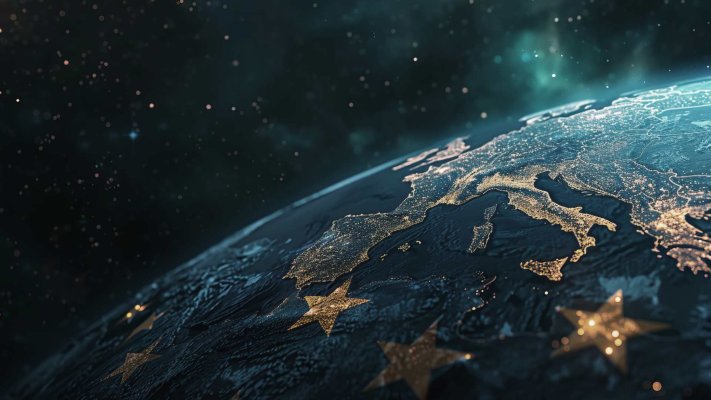
As European resident who is also a personal friend of the vice president, I am often asked on my continental travels: Does J.D. Vance hate Europe? Of course he doesn’t! In fact, Vance loves Europe, and has taken an even keener interest in it since his 2019 conversion to Catholicism.
Can Europe survive its current omnicrisis? Mass migration is the main cause, but in truth, that is only the most potent manifestation of the continent’s loss of faith in itself and its own civilization. Earlier this year, J.D. Vance, the US vice president, scandalized Europe’s leadership class with a landmark speech in Munich warning them that Europe’s greatest threat comes not from Russia, but from its own inability to manage its own sad decline. The conference’s German host literally wept publicly after the speech. The European ruling class fell into paroxysms of self-pity and outrage, wailing and gnashing their teeth over what they considered to be America’s abandoning them. Many European conservatives, though, welcomed the address, grateful that a senior American leader recognized what they had been saying for years: that Europe must learn to take responsibility for its own affairs, and deal forthrightly with the cancers growing inside the European body politic.
As European resident who is also a personal friend of the vice president, I am often asked on my continental travels: Does J.D. Vance hate Europe? Of course he doesn’t! In fact, Vance loves Europe, and has taken an even keener interest in it since his 2019 conversion to Catholicism. But his is a tough love, not the kind of sentimental enabling of the beloved in her self-destructive ways. As part of his ongoing education about Europe and its challenges, the vice president recently hosted Hungarian prime minister Viktor Orban and a small retinue, including me, in the library of his residence. Over drinks, Vance queried the Hungarian leader about Europe’s condition. At one point, Orban, a Calvinist, repeated something he has said many times in his years as prime minister: that Europe will not recover until and unless it rediscovers its ancestral faith: Christianity.
This is a view I have held for many years; living full time in Europe since 2022 has only deepened that conviction. Alas, this is not a matter for politics alone. Orban has rightly said that politics cannot provide people with meaning. At its best, it can provide meaning-giving institutions – chief among them the churches – with the liberties and the resources to do their proper work. But if these institutions fail to act within the space opened for them by politics, then nothing that politicians do to address the meaning crisis will matter. “The problem,” I told the prime minister and the vice president, “is that few people in Europe go to church anymore. Not even in Hungary.” The prime minister sighed. He knows it is true. We all do. And we don’t know what to do about it.
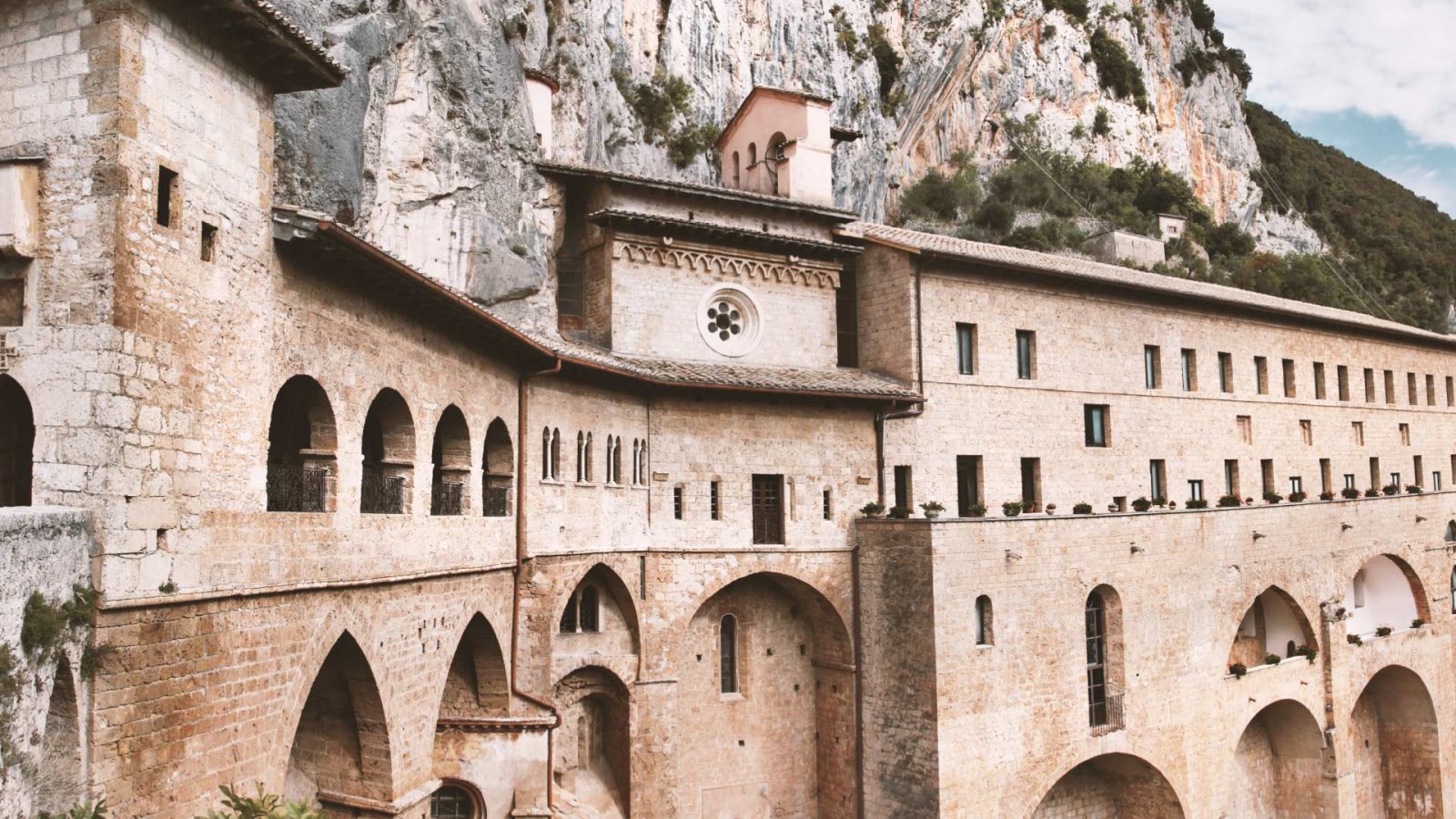
Or don’t we? Europe has been here before, when, after decades of decline, the Western Roman Empire whimpered to its conclusion in 476, when the last Western emperor capitulated to the barbarian strongman Odoacer in Ravenna. Four years later, in an Umbrian mountain village, a young man known to history as Benedict of Nursia was born to devout Christian parents. Around the year 500, Benedict’s parents sent him down to Rome to complete his education. Before Rome’s sack by Visigoths in 410, Rome had been home to one million souls. By the time Benedict arrived at its gates, only 100,000 Romans were left picking over the ruins. The pious young scholar from the provinces found the chaos and immorality of the once-great imperial city overwhelming. He judged that if he remained there, he might lose his faith. Eventually Benedict took refuge in a cliffside cave near Subiaco, a village 50 km east of Rome. For three years he dwelled in darkness there, in prayer and contemplation, fed by the charity of Romanus, a monk from a nearby monastery, who lowered food by rope to Benedict in a pail.
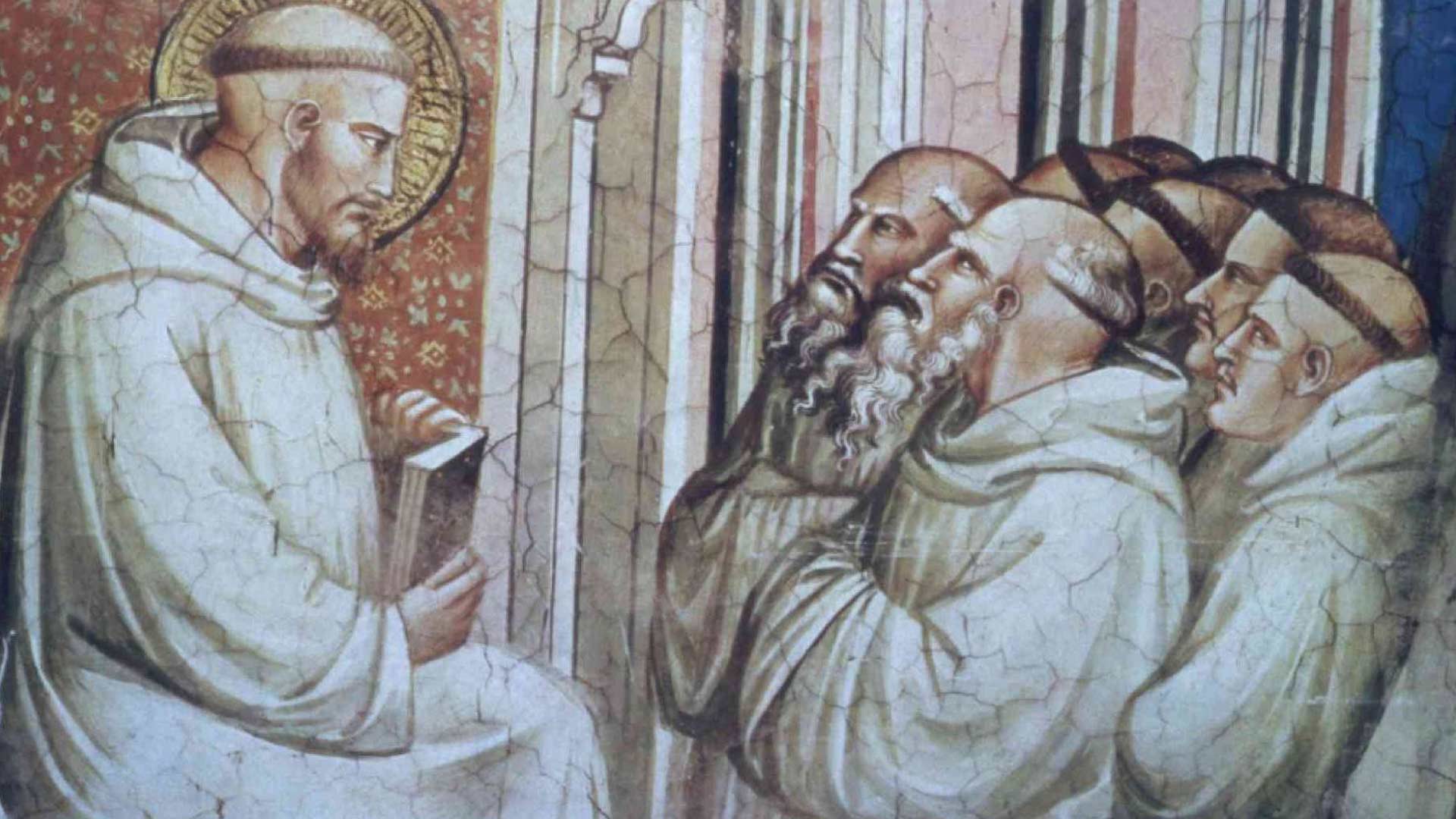
When Benedict emerged, he had a reputation for sanctity, and was invited by a monastic community to be their abbot. By the time he died in the year 547, Benedict had founded twelve monasteries, and written his famous Rule, which would in time become the “source code,” so to speak, for a vast constellation of monasteries and convents that would appear throughout western Europe in the centuries to come. The Rule is a short, simple guide to living in Christian community – what Benedict called “a school for the Lord’s service.” It is not a mystical tract or a deep theological pamphlet. Rather, the Rule is a practical guide for how to dwell together in prayer, simplicity, and disciplined community. Benedict did not set out to Make Rome Great Again, or in any way to recover the political strength of the lose empire. The guiding star of the Rule was the search for God; it was, in a sense, a map for pilgrims.
Benedictine monasticism arose in a time and place in great crisis. The fall of the Empire was a total catastrophe for western Europe. Though poor and beset by untold challenges, the Church was the only effective government in most places. Their quest for God led the early Benedictines to build monastic communities in rural places, where they provided much-needed help and hope to the peasantry. Tens of thousands of young men and women flocked to the Benedictines, taking up residence behind monastery walls. Though semi-cloistered, the Benedictines maintained active relationships with the laity. They taught them the Gospel, and showed them how to. Pray. But the monks also taught them how to grow and build things, using knowledge that had been lost to most people in the Empire’s fall. And, within the libraries of those fortresses of faith, the monks preserved holy books, both sacred and profane. The monasteries became like arks floating atop the turbulent sea of early medieval Europe. They prepared Europe for the birth of a new, Christian civilization. This is why some scholars consider the Rule second only to the Bible as the most influential text of European history.
What did the two popes see that led them to that apocalyptic conclusion? Demographic decline, Mass migration, Spiritual and moral collapse...
When he retreated to Subiaco, Benedict planted himself in the stony cliff like a mustard seed. He produced, by writing and example, a method of seeking and serving God in a community of faith constructed to withstand a world of chaos and decadence. This is the kind of creative faith the West desperately needs today, more than it has in fifteen centuries. Why? Because today, we are like Rome on the verge of civilizational collapse.
This is not the diagnosis of a mad prophet living in the Black Forest, eating locusts and honey. This is the diagnosis of two recent popes. In a 1999 address to the synod of European bishops, Pope St. John Paul II said, “Europe today risks following the path of the ancient Roman Empire, which collapsed not only because of external invasions, but above all because of internal decay, moral corruption, and the loss of faith in its own values.” In 2003, the ailing pontiff repeated the warning: “Like the Roman Empire in its final phase, Europe seems to be sliding toward a form of cultural suicide if it does not rediscover its Christian soul.” Shortly after succeeding John Paul as pope, Benedict XVI addressed the World Youth Day gathering in Cologne, telling the crowd, “Just as the Roman Empire fell, so too the great cultural structures of the West are in danger of collapsing if they lose their moral and spiritual foundations.” And again, in a 2007 address to Europe’s bishops, Benedict XVI said, “Europe today is like the Roman Empire at the time of its decline: it is losing its identity, its vitality, and its future.”
What did the two popes see that led them to that apocalyptic conclusion?
Demographic decline: the refusal of native European populations to have children at replacement rates indicated a loss of faith in the future, or perhaps an individualistic choice to exchange the prospect of starting families for the promise of a richer and freer material life.
Mass migration: In late imperial Rome, fertility decline contributed to the inability of the state to control its borders. Plus, the state needed manpower, which the more fertile barbarian tribes provided. Though barbarian tribes were later Christianized, their initial migration into what was once Roman territory became both necessary and inevitable. Similarly, mass internal migration of Roman peasants from the countryside into cities fractured family ties and spread individualism.
Spiritual and moral collapse: Though the late Roman Empire was officially Christian, the faith had not penetrated deeply enough in the West in time to revitalize a demoralized population. The Roman family form disintegrated from the spread of individualism, including easy divorce, and Romans lost their pietas, the virtue of respect for the gods, family, authority, and the past. Harvard sociologist Carle C. Zimmerman wrote: “The Roman family system, which had been the backbone of the state, disintegrated… The final result was a low birth rate, a high death rate, and a population which could not reproduce itself. The empire fell because it had no families to hold it together.” (Zimmerman, ‘Family And Civilization,’ (1947, p. 308)
John Paul and Benedict identified all these factors in contemporary Europe. Today, demographers throughout the West note that the only people who defy the widespread collapse in fertility are highly committed religious traditionalists, such as Orthodox Jews and Anabaptist sects in North America. Most Christians, though, are going along with the crowd, over the demographic cliff.
The crisis is at its worst in Europe, but is general throughout the West, including in my native country, the United States. In 2017, I published a bestselling book titled The Benedict Option, in which I too compared the situation in the West today to fifth-century Rome, and encouraged Christian readers to look to the example of St. Benedict and his followers as a way forward through this seemingly terminal crisis. In the book, I quoted lines from Father Joseph Ratzinger in 1969, in which the future Benedict XVI predicted a coming collapse in the Catholic Church’s power, authority, and numbers. He prophesied that the Church would be reduced to a relatively small number of the truly devout, but these small groups would prepare the ground for rebirth.
My book endorsed Ratzinger’s bleak but hopeful vision, and his subsequent call for Christians to be “creative minorities” in a post-Christian society. If the laity – Catholics, Protestants, and Orthodox – can find ways to adapt the general Benedictine model of disciplined communal living to their particular circumstances, we stand a good chance not only of surviving the long civilizational winter, but emerging to re-evangelize a world in need of the Gospel. The Benedict Option sold well in the United States, and was eventually translated into ten languages. In 2018, at a media event in Rome, Archbishop Georg Gänswein, then the private secretary to the Pope Emeritus, delivered a speech praising the book saying it is not only “a strategy for Christians in a post-Christian society; it is a call to live the faith with courage and joy, even in the midst of the storm.” Vatican journalists told me this is as close as I could get to an endorsement from the great Benedict XVI himself.
What are the political implications of all this for Europe today? Are there lessons we can draw from the Benedict Option that apply beyond the call for creative lay minorities to found communities of faith? I believe there are, but it will require European political leaders to reconsider radically the entire model of its postwar development.
In 1941, with Nazi armies overrunning Europe and the victory of fascism seemingly fated, two left-wing Italian intellectuals, Altiero Spinelli and Ernesto Rossi, with additional help by Eugenio Colorni, penned a document that came to be known as The Ventotene Manifesto. Written in secret while Spinelli and Rossi were imprisoned on the Italian island of Ventotene, the manifesto has been called the Magna Carta of European federalism. Its authors saw nationalism as the root cause of totalitarianism and the world war. Nation-states and their imperialism started the war; only “the abolition of the division of Europe into national, sovereign states” could guarantee peace after the war ends. They proposed a European federation, governed by a transnational authority, sharing a common currency, and defended by a unified army. Under the Ventotene plan, each nation-state would “retain the autonomy it needs for a plastic articulation and development of a political life according to the particular characteristics of the people.” But the greater power would be held by “a solid international State” that would implement socialist reforms.
In 1944, Spinelli founded the European Federalist Movement. The Ventotene Manifesto informed the 1950 Schuman Declaration, named after Robert Schuman, the foreign minister of France. The core idea was to lay the foundation for permanent piece by abolishing the historic enmity between France and Germany. With the approval of West German chancellor Konrad Adenauer, the Schuman Declaration mandated the integration of the coal and steel industries of the two nations, as the core of a future economic federation of European states.
This was to be the first step towards what Schuman hoped would “lead to the realization of the first concrete foundation of a European federation indispensable to the preservation of peace.” One year later, in 1951, six countries – France, Germany, Italy, the Netherlands, and Luxembourg – signed the Treaty of Paris, establishing the European Coal and Steel Community (ECSC). In 1957, the Treaty of Rome created the European Economic Community (EEC), and in 1973, the EEC accepted three more members: Great Britain, Ireland, and Denmark. The 1980s brought more members – Greece, Spain, and Portugal – and deepening integration. After the 1989 collapse of the Berlin Wall, pressure built to accelerate the federalist plan. The Maastricht Treaty of 1992 formally created the European Union (EU). Three years later, Austria, Finland, and Sweden joined, and the Schengen agreement, effectively abolishing internal borders, went into effect. In 2002, twelve EU countries adopted a common currency, the euro. Within five years, a dozen more nations, including a number of former Soviet bloc countries, had joined the EU, though not all accepted the currency union.
A major stumbling block came in 2003, with the failure of the draft European Constitution. The constitution required unanimous support from voters in member states, but when French and Dutch voters rejected it, the constitution was effectively dead. Majorities in both countries hesitated over fears that the document would take away too much sovereignty (Netherlands), and impose a neoliberal Anglo-Saxon economic model (France). Voters also expressed concern that the constitution was the product of a transnational elite out of touch with the people.
Yet Catholic leaders, including Pope John Paul II, voiced serious concern about the constitution during the drafting period. The document elided over 1,500 year of Europe’s Christian history, as if the continent had gone from antiquity to modernity with no intervening religious period – over a thousand years in which what was once called “Christendom” emerged, and built Europe. As Catholic Rocco Buttiglione later observed, “How strange was that? All values could be mentioned: the Greek and Roman heritage, the Enlightenment, but not Christianity. But without the Bible, the Enlightenment would not have been there.” Prominent Catholics sounded the alarm about the fundamentalist secularism of the document. “The Constitution’s silence on God is a betrayal of Europe’s soul,” thundered then-Cardinal Joseph Ratzinger. For his part, Italian Cardinal Camillo Ruini declared, “A Europe without God will become a Europe against man.”
The fullest statement of the cost of leaving out the Christian keystone in constructing the arch of the new Europe came from John Paul II, in his lengthy 2003 exhortation, Ecclesia in Europa (The Church in Europe). In it, the Polish pontiff decried“the loss of Europe’s Christian memory and heritage, accompanied by a kind of practical agnosticism and religious indifference whereby many Europeans give the impression of living without spiritual roots and somewhat like heirs who have squandered a patrimony entrusted to them by history. It is no real surprise, then, that there are efforts to create a vision of Europe which ignore its religious heritage, and in particular, its profound Christian soul, asserting the rights of the peoples who make up Europe without grafting those rights on to the trunk which is enlivened by the sap of Christianity.”
John Paul said Europe was turning into a mere museum of Christian symbols, among which dwelled a lost and confused people marked by “fear of the future.” He saw the diminishing rates of marriage and births, broken families, and the dwindling number of vocations to clerical life, as signs of “existential fragmentation” and the growing triumph of a “culture of death.” Europe at the dawn of the 21st century, said the pope, was engaged in “an attempt to promote a vision of man apart from God and apart from Christ.” Look no further, he said, than the refusal of the European Constitution drafters to include reference to Christianity in the document. A union of European nations based only on geography and economy, and leaving out moral virtue, will lack substance.
The great pontiff, then entering his final physical decline, begged the peoples of Europe to remember their Christian pietas. In these anguished words, we hear the voice of a saint who saw off a totalitarian atheist regime, only to witness, in his final years, the coming of a liberal democratic version: “Taking up anew this invitation to hope, I repeat to you again today: Europe, as you stand at the beginning of the third millennium, “Open the doors to Christ! Be yourself. Rediscover your origins. Relive your roots”. Down the centuries you have received the treasure of Christian faith. It has grounded your life as a society on principles drawn from the Gospel, and traces of this are evident in the art, literature, thought and culture of your nations. But this heritage does not belong just to the past; it is a project in the making, to be passed on to future generations, for it has indelibly marked the life of the individuals and peoples who together have forged the continent of Europe.”
Two years later, John Paul II descended to the grave. Two years later, in 2007, the Treaty of Lisbon, the successor document to the failed European Constitution, was signed in that city’s Jeronimos Monastery. It went into effect in 2009. The treaty was scarcely different than the Constitution it replaced. In its pages, God was still dead.
Since 2009, Europe – still relatively prosperous, still relatively free – has continued its death rattle.
Consider the factor at the heart of the religious analysis: the faith. According to surveys, Christian affiliation across the EU – that is, the number of Europeans identifying as Christian – has declined from around 75 percent to 64 percent. France and Great Britain both lost their Christian majorities after 2009. The more important figure – the number of Christians who go to church – has accelerated. Across the EU, only 18 percent of Christians report attending services weekly or monthly. If it weren’t for the relatively high number of churchgoers in Italy and Poland, the EU number would be much lower. Thousands of churches, both Catholic and Protestant, are closing or merging.
The overall birth rate continues to plummet, now at 1.46 – far below the replacement rate of 2.1 births per female. Italy (1.24) and Spain (1.16), in particular, become fertility deserts. No country – not even Hungary, with its unusually generous tax and welfare benefits offered to large families – has figured out how to reverse the decline. European economies have stagnated. Growth is virtually non-existent, with stifling regulations quashing innovation. Of the world’s top 25 most valuable companies by market capitalization, Danish drug manufacture Novo Nordisk (No. 25) is the only European country on the list. Some countries – France in particular – are struggling with high levels of debt and political paralysis that makes economic reform difficult. And Europe cannot defend itself. The panic that J.D. Vance’s Munich speech set off had much to do with the fact that Europe’s NATO countries had long depended on the presence of the US Armed Forces, allowing them to reduce defense spending and pour money into social welfare programs. European militaries lack material and military readiness.
What’s more, most Europeans surveyed don’t think they live in countries worth fighting for. Polls show that most Europeans say they would refuse to a poll earlier. A 2024 Gallup poll found only 33 percent of Europeans saying they would fight if their country were invaded (the numbers are higher for European nations geographically closer to Russia). A separate poll of Germans in the summer of 2025 found that 44 percent of those surveyed said they definitely would not defend Germany if it were invaded, with an additional 13 percent saying they “probably” would not. As the Austrian commentator Ralph Schöllhammer quipped, “Germans don’t even want to defend their own country, but you think they will fight for [Ukraine]?” He added, “As it turns out, postmodern-secular-hyper rationalism is a lot of fun in peace times, but leaves you utterly defenseless during times of conflict. The future belongs to those willing to fight for it.”
Cultural malaise is general throughout Europe. Without belief in God and a transcendent meaning to life, people have no motivation to live sacrificially to perpetuate their social order. Europeans began by ceasing to believe in God, and are ending by ceasing to believe in Europe.
Which brings us to the most pressing issue facing the continent today: mass migration, especially from Islamic countries. Defense experts like Britain’s David Betz and France’s Thibault de Montbrial warn that the countries of western Europe is nearing the brink of civil wars. Mass migration, which governing authorities have been unable or unwilling to stop, is pushing native populations to the brink of revolt. Crime rates, driven by migrants, are skyrocketing. Housing shortages are growing worse because of all the newcomers. Political and religious violence caused by Islamic extremists tests the tolerance of Europeans, whose governments often respond by cracking down not on migrants, but on those who complain about them.
And yet, the European Union carries on with plans to force member nations like Poland, Hungary, Slovakia, and Czechia, which have all rejected requests to receive western Europe’s migrant overflow, to do Brussels’ bidding. As of this writing, the EU is threatening to impose fines on member countries that resist. Since June 13, 2024, Hungary has been paying a fine of €1 million per day imposed by the European Court of Justice for the Magyar nation’s refusal to admit so-called asylum seekers.
In sum, the postwar dreams of a united, federalist Europe governed by a superstate headquartered in Brussels are in trouble. For all that, clear majorities in Europe support the European Union project, and show relatively high levels of trust in the EU. A Spring 2025 Eurobarometer survey across all 27 member states found that an average of 74 percent of EU citizens believe their country benefits overall from EU membership, while 52 percent expressed trust in the EU – an 18-year high. How to explain the EU’s positive numbers amid a growing sense of crisis and fear of decline in individual countries? It is likely that Europeans feel threatened by Russia’s aggression against Ukraine, and, despite the alliance’s feeble defense capabilities absent American support, feel psychologically comforted by the sense of continental unity the EU provides. It is also the case that despite Europe’s chronic economic woes, most Europeans believe that EU membership gives them greater financial security.
There is a better way – a way that satisfies Europeans’ desire for a more unified, cooperative civilizational bloc, while jettisoning the overbearing ideologies that Eurocrats in Brussels impose on unwilling peoples of the diverse continent. In 2024, on the Feast of St. Benedict, European parliamentarians of the European Conservatives and Reformists (ECR) bloc gathered in Subiaco to sign a Charter Of Values. The goal is not to abolish the European Union, but to reform it to make it better serve member states and their vital interests.
The Ventotene Manifesto prescribed a federalist, secular Europe in which national distinctions were suppressed in the service of unity, socialism, and globalism – which Europe has more or less achieved. But it has made Europe weaker in fundamental ways that are becoming harder to deny, especially now that the United States has made clear that Europe has to stand on its own feet in terms of self-defense. Once again, despite telling pollsters how much they believe in the EU, the unwillingness of most Europeans to fight for their countries, or even to make babies for their countries, is a more honest measure of Europe’s civic health. By contrast, the Subiaco Charter calls for a return to Christianity, tradition, the natural family, and meaningful respect for national sovereignty within a broader framework of unity. As the Charter. Says: “We do not accept the fake choice between more Europe and no Europe. Instead we believe that, while valuing cooperation among European nations, limiting any undue interference is essential for maintaining the unique cultural and historical identities of our Member States and guaranteeing national sovereignty.”
The Charter recognizes that each European nation developed under different conditions, and has a right to it own values, as opposed to having the godless progressivism favored by the Eurocrat class forced on them from faraway Brussels: “We advocate for a society that embrace diversity of thought. We firmly oppose an EU intended as a tool for the realisation of a globalist agenda aiming to impose progressive single thinking and ethical relativism. Instead, we encourage open dialogue and respectful exchange of ideas, recognising the richness that comes from a variety of perspectives.” In other words, let Spain be Spain, and let Hungary be Hungary.
For example, Spain has long been one of the world’s most progressive countries on LGBT laws, in conformity with the militant universalist liberalism of the EU ruling caste. By contrast, Hungary under Viktor Orban’s leadership is a bone in the EU’s throat. In 2021, Orban’s Fidesz Party passed a law banning LGBT “propaganda” aimed at minors and schoolchildren. Fidesz said Brussels’ sexually permissive pedagogy violates the values of the culturally conservative nation. Enraged EU leaders condemned Hungary, with Mark Rutte, then the prime minister of the Netherlands, saying Hungary should be expelled from the EU over the matter. A generation ago, Orban’s conservate views– e.g., don’t force Drag Queen Story Hour on little children --would have been closer to the European norm than Rutte’s. The fact that Rutte, who is now the NATO secretary-general, would have a thousand-year-old European nation that was for centuries a bulwark against Islamic invasion thrown out of the EU over teaching gender ideology to kids is a sign of profound decadence.
Be that as it may, the Subiaco Charter does not attempt to impose Christian virtue on any member state. It simply asks for tolerating cultural diversity. While this might sound weak to more robust individual Christians, this approach has the virtue of being realistic about the fragile state of the Christian faith on the continent where it was first developed. After all, the faith cannot be revived from the top down. Consider the case of Viktor Orban’s Hungary. The Magyar leader and his party wrote Christianity into the country’s post-communist constitution, the Fundamental Law, as the basis for the nation’s laws. The Fundamental Law does not make Hungary a confessional state – the population is divided between a Catholic majority, with significant minorities of Protestants and unbelievers. Rather, the constitution recognizes Christianity as the historical foundation for the nation’s identity and the source of its morality.
This reasonable approach has, in practice, opened a space for churches and religious organization to thrive. And yet, they have not done so. A Catholic sociologist at a Hungarian university lamented to me that the only vibrant religious communities in the country are the tiny Orthodox Jewish sects, and a large non-denominational Protestant megachurch with satellite campuses. Churchgoing rates remain low among both Catholics and Protestants. Alas, this is not a problem that politicians are in a position to fix.
It is worth noting that Orban recognizes that cultural strength depends both on the protection of churches and distinct nations – a strategy that directly opposes the goals and methods of the secular Ventotene-style model that has dominated Europe in the postwar period. It dovetails perfectly with the Subiaco Charter’s call for maintaining the unique cultural and historical identities of our Member States and guaranteeing national sovereignty.” And it is consonant with the words of ECR Co-President Nicola Procaccini, upon the declaration of the Subiaco Charter in 2024. Said Procaccini, “We conservatives want to protect the classical values and the Judeo-Christian roots that are decisive for the formation of the EU to come. Forgetting the past, as the mainstream ‘cancel culture’ would have it, means jeopardizing the future.”
It is here that the Benedictine model can guide us in another way. Though the early Benedictines depended on the patronage of Pope St. Gregory the Great, who favored the Rule over competing forms of monasticism, the Benedictines’ true success came with their slow, organic growth over time. As St. John Henry Newman wrote in his essay “The Mission of St. Benedict” (1858):
When the bodily frame receives an injury, or is seized with some sudden malady, nature may be expected to set right the evil, if left to itself, but she requires time; science comes to shorten the process, and is violent that it may be certain. This may be taken to illustrate St. Benedict’s mode of counteracting the miseries of life. He found the world, physical and social, in ruins, and his mission was to restore it in the way, not of science, but of nature, not as if setting about to do it, nor professing to do it, by any set time or by any rare specific or by any series of strokes, but so quietly, patiently, gradually, that often, till the work was done, it was not known to be doing. It was a restoration rather than a visitation, correction, or conversion. The new world which he helped to create was a growth rather than a structure. Silent men were observed about the country, or discovered in the forest, digging, clearing, and building; and other silent men, men not seen, were sitting in the cold cloister, trying their eyes, and keeping their attention on the stretch, while they painfully deciphered and copied and re-copied the manuscripts which they had saved. There was no one that “contended or cried out,” or drew attention to what was going on; but by degrees the woody swamp became a hermitage, a religious house, a farm, an abbey, a village, a seminary, a school of learning, and a city. Roads and bridges connected it with other abbeys and cities, which had similarly grown up; and what the haughty Alaric or fierce Attila had broken to pieces, these patient meditative men had brought together and made to live again.
According to Newman, declared at his 2019 canonization to be a “Doctor of the Church,” the special gift of the Benedictines was “poetical perception,” as distinct from an analytical, systematic, scientific stance toward the world.
It demands, as its primary condition, that we should not put ourselves above the objects. In which it resides, but at their feet; that we should feel them to be above and beyond us, that we should look up to them, and that, instead of fancying that we can comprehend them, we should take for granted that we are surrounded and comprehended by them ourselves. It implies that we understand. Them to be vast, immeasurable, impenetrable, inscrutable, mysterious; so that at bet we are only forming conjectures about them, not conclusions, for the phenomena which they present admit of many explanations, and we cannot know the true one. Poetry does not address the reason, but the imagination and affections; it leads to admiration, enthusiasm, devotion, love. The vague, the. uncertain, the irregular, the sudden, are among its attributes or sources. Hence it is that a child’s mind is so full of poetry, because he knows so little; and. An old man of the world so devoid of poetry, because his experience of facts is so wide.
Newman’s approach finds contemporary resonance in the work of the British psychiatrist and cultural theorist Iain McGilchrist, who locates the source of the modern world’s malaise and brokenness in the early modern preferential option for the analytic over the poetic. In McGilchrist’s analysis, the propulsive urge to understand the world through empirical study – the function of the brain’s left hemisphere – gave Western man unusual power over the material world, but at the cost of losing a deeper sense of its meaning. He advocates a balancing return to art, poetry, liturgy, and other aesthetic approaches to contemplating the divinely-given mysteries of Creation. These two ways of knowing must not be opposed, but should work symphonically to produce a more accurate and fruitful – and dare I say, sacramental -- way of participating in the life of the world.
The difference between a tourist and a pilgrim is that the tourist sees all these beautiful things, but doesn’t see them as pointing towards God. A pilgrim experiences the same beautiful things, but recognizes them as pointing to God.
Indeed, Pope Benedict XVI, who took his papal name in homage to the saint of Nursia, one of the patrons of Europe, frequently spoke of the theophanic and evangelical qualities of beauty. In a 2010 interview with his biographer Peter Seewald, Benedict observed: “The only really effective apologia for Christianity comes down to two arguments: the saints the Church has produced and the art which has grown in her womb. Better witness is borne by the splendor of holiness and art than by clever excuses apologists have spun.”
The example of the saints can be understood as a form of moral beauty. In both cases – moral and aesthetic beauty – the reality of God can be directly perceived. Pope Benedict called this the “via pulchritudinis,” or way of beauty, saying that it “opens the human spirit to the sense of the eternal.”
In June 2025, I saw a 20,000-strong multitude of young Catholics – mostly French, but also some from other European nations – undertake the via pulchritudinis on a three-day walking pilgrimage from Paris to Chartres. This was the 43rd annual Pentecost weekend pilgrimage taken by young Catholics devoted to the traditional Latin mass. Their walk began with mass at the church of St. Sulpice in central Paris, and ended on Pentecost Monday at the great medieval cathedral rising on the plains of Beauce, some 60 km from the French capital.
Interviewing the pilgrims (average age: 19) at the start of their walk, what struck me was their sense of joy. They seemed serenely aware of their lonely condition as believers living in a society that had lost its faith, and therefore its way. They saw themselves as on a holy quest, the quaerere Deum (“to seek God”) that is the spiritual core of the Benedictine life. If I could sum up the collective message I received from them in those interviews and conversion, it would go like this: We were given nothing by our parents. We are looking for God, for transcendence, for purpose, for stability, and for community. These young people are the offspring of the great deculturation imposed on them by their forebears who built postwar Europe. They were taught that God is dead, or at least marginal to the reality of life. They were taught that science is the only reliable source of meaning, and that they are free (or, one might say, condemned) to create individual purpose from their own unfettered choices. And they were formed to think that loving their nation and the cultures of their particular nations was a fault that led to chauvinism, and perhaps even to violence.
At the start of the pilgrimage, I spoke to a young man from Canada, Matthew Witzane, who said we may be at the beginning of a Christian renewal. He sees small Catholic communities emerging everywhere in North America. I told him that I am aware of the same thing happening in France and Italy. Witzane said that he had come to the Chartres pilgrimage because he wanted to experience Europe “not as a tourist, but as a pilgrim.” “The difference between a tourist and a pilgrim is that the tourist sees all these beautiful things, but doesn’t see them as pointing towards God,” he said. “A pilgrim experiences the same beautiful things, but recognizes them as pointing to God.” Three days later, I sat in the crowded nave of the Chartres cathedral, watching a seemingly endless parade of youth, with beaming faces, process in, carrying flags of their nations and regions, and banners proclaiming devotion to local saints. This is Christendom, I thought.
After the mass, I saw a young Belgian man sitting with his friends on the cathedral’s lawn, drinking a beer with his sneakers at his side. Sunburned, exhausted, but visibly happy, Alexandre Gaubert, 22, told me, “Christ gave us the power to come here. My feet are in pain, but my heart feels good.” Something is happening with the Catholic youth of France – and it’s happening without the involvement of the bishops (France’s episcopate takes a dim view of the enthusiasm for the traditional Latin rite). Maria-Katrina Cortez, a researcher on French religion and politics at the Centre for European Studies and Comparative Politics in Paris, said that while religious faith and practice continues to decline overall in the country, French adults under the age of 34 believe in and practice their faith at nearly double the rate of the older generations. While fewer young French call themselves Catholic, the ones who do are serious about it. Said Cortez: “This isn’t a mass revival, numerically speaking. It is a qualitative rather than quantitative resurgence.”
Very well. The Benedictine movement of the early medieval period started small, but flourished because of its discipline, and because those monks and nuns offered to the lost and harried peasants of Dark Ages Europe a better way of life. Who knows where this organic movement arising from the laity will lead? Those searching Catholic youth know all too well that the godless, globalist, post-national society and culture bequeathed to them by their parents and grandparents leads nowhere. They are looking to Europe’s deep past for a path out of modernity’s dark wood.
Thanks to the long Christian heritage disdained by the technocrats of Brussels, Europe has inherited material gifts that too many Europeans fail to see, but which are vividly and delightfully clear to North Americans.
Standing outside of St. Sulpice at the start of the pilgrimage, an American priest leading a group of Catholic high school boys spoke of having spent the previous week with them at the traditionalist monastery of Fontgombault. The boys had been dazzled by the beauty and the spiritual depth of traditional Benedictine monasticism. They had never seen anything like it. “When they come here, one of the things they experience is that a joyful Catholic life is possible,” the priest told me. “In the United States, people feel very isolated from that, because we don’t have the cultural heritage that points us in that direction. So, when the boys experience that, they realize it’s not just a storybook fantasy.” “You have to know where you’re coming from, where you’re going to, and what you’re bringing with you, to have any sort of successful life or journey,” he went on. “Things like the Chartres pilgrimage are giving people a sense of reorientation, which they carry into the world.”
I left Chartres convinced that if Europe is to be saved from its omnicrisis, that salvation won’t come through its political leadership, nor from its ecclesial hierarchy, which, in the Catholic case, seems more determined to advocate for open borders bringing ever more Muslims into de-Christianized Europe than dedicated to fostering things like the Chartres pilgrimage. That salvation will come through young men and women like these pilgrims, who celebrated in fellowship their common faith, but also, through banners and hymns in their own languages, their particular nations, which emerged from the Gospel being received and developed according to the ways of their people.
True, Europe in the 21st century is incomparably richer and more peaceful than the world into which St. Benedict was born, and began his world-changing mission. But that material abundance and social order is a mask that conceals deep corruption. As Aleksandr Solzhenitsyn said: “The strength or weakness of a society depends more on the level of its spiritual life than on its level of industrialization. Neither a market economy nor even general abundance constitutes the crowning achievement of human life. If a nation’s spiritual energies have been exhausted, it will not be saved from collapse by the most perfect government structure or by any industrial development. A tree with a rotten core cannot stand.”
True, politics alone cannot renew a decadent society. But politics can clear a space for renewal movements, both spiritual and cultural, and defend them from the cultured barbarians who seem them as threats to the post-national, post-Christian dystopia they have created, but insist on calling paradise. This is the historical lesson of Subiaco, and the promise of the Subiaco Charter. The early medieval church hierarchy could not have commanded the green shoot of a St. Benedict to arise from the rocks of his cave hermitage. But rise he did, thanks to divine providence. Let’s not forget, though, that if his early followers had not had as a patron the most powerful politician in the early medieval church, Pope St. Gregory the Great, the monastic order that helped create Europe might never have taken off.
Gregory, whose reign began in 590, more than half a century after Benedict’s death, wrote the only biography we have of the saint. So taken was the pope by the Benedictine model that he protected the monks from episcopal interference, encouraged their missionary work, and promoted them in hundreds of letters to barbarian rulers. In a sense, St. Benedict needed St. Gregory the Great.
In our time, would-be spiritual reformers like the Chartres pilgrims, and leaders of nascent lay Christian communities, like the vibrant Tipi Loschi of San Benedetto del Tronto, in Italy, not only need protection and encouragement within the government of the Church, but also patronage and defense by secular lawmakers. Yet the initiative to take the first steps on Europe’s grand pilgrimage of civilizational restoration must come from within the hearts of believers themselves – the “creative minorities” foreseen by Benedict XVI.
Though modern Europe has become a spiritual desert, the Lord has nevertheless scattered seeds here. We must all become pilgrims, yes -- but also careful gardeners. The future of Europe will not be decided in Brussels or Rome, but rather in the forgotten places of the Ventotene Empire, in the Subiacos where, what the haughty Eurocrats and godless globalists have broken to pieces, these patient meditative young men and women will bring together, and make to live again.