
The human being is a disruptive element within the Earth’s ecosystem, an excessive presence to be contained, limited or corrected, if not eliminated altogether.
Once upon a time, there were social rights, the beating heart of the revolutionary march of the Western left, based on the familiar framework of the class struggle between the proletariat and the bourgeoisie, workers and employers. They were the soul of a red flag which, however, over time, has had to turn increasingly fuchsia as the Western left has become the very armed wing of the capitalism they claimed to want to fight. How, then, could they justify this change of allegiance to their electorate and the public? How could they revive the mobilising framework of class struggle if the defence of social rights was no longer the priority and the ‘boss’ was the new friend? By replacing the category of rights to fight for, eliminating the ‘social’ ones and substituting them with ‘civil’ rights.
This is the genesis of the transformation of the ‘socialist’ left into the ‘progressive’ left, founded on two pillars: the battle for vocal minority rights, transposing (and distorting) the concept of class struggle into the hierarchy of grievances between increasingly subdivided groups, and the battle for the environment, creating a class struggle between defenders of nature and polluters. The latter is the most insidious because it manages to create a conflict in an area where there should be no reason for one to exist: for what person, indeed, would not fundamentally agree that we must preserve the place where we live as much as possible? What person would fundamentally be in favour of poisoning the water they drink or the food they eat?
And yet, perhaps to ensure that this realisation would lead to a consensus of intent, progressive pseudo-environmentalism has managed to create a further conflict within its own irreconcilable narrative: that between Man and Nature, the former being the latter’s principal enemy. Thus, every problem now seems to lead to the same conclusion: the human being is a disruptive element within the Earth’s ecosystem, an excessive presence to be contained, limited or corrected, if not eliminated altogether. An environmentalism whose aim is to blame humanity rather than understand its role in the world and preserve the harmony of the whole.
The reaction from the right, in opposition to this, has in some cases resulted in an equally risky approach: that of regarding Man as the owner of Nature, and Nature as a tool for Man’s work. Or in closing our eyes and denying that the socio-economic model in which we live is having effects on our ecosystem that we must take into account and which may backfire, but also that Nature has its own life cycles and evolutions that transcend us and which we can only manipulate to a limited extent, having – whether we like it or not – to largely endure them. The debate surrounding global warming is emblematic: between those who say it is man’s fault and those who say it does not exist, it is as if no hypothesis can be considered that does not include the idea that there might be something with its own dynamics independent of man, which man cannot control and in the face of which man is a passive subject whose only room for manoeuvre is to adapt.
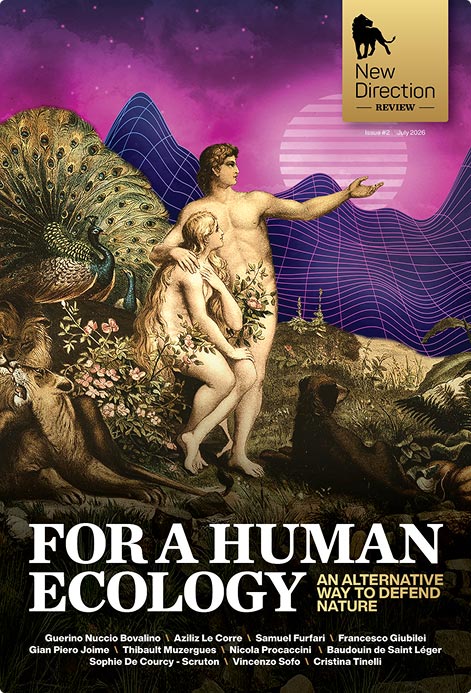
Yet, between the anti-human and the ultra-human perspectives, there is a third that does nothing more than return to the fundamentals of our civilisation. Viewing Nature as Creation and Man as the central element of this creation, entrusted with understanding, protecting and passing it on to future generations. This is why he should not be blamed but empowered, not marginalised but placed back at the centre. Human ecology.
This perspective allows us to reconcile economic and social growth with environmental protection, overcoming the dichotomy between progress and conservation. But above all, it shields us from one of modernity’s most profound excesses: the transhumanist conception of humanity. For if the human being is regarded as a problem, it becomes natural to imagine that they must be corrected, modified. Not only in their habits and customs, but also in their biological, natural constraints. And it is here that the philosophical short-circuit of progressive ecology becomes apparent, whereby the ‘biological’ applies to the courgette but not to man.
Conservative ecological thinking must therefore be a holistic approach, aimed at reshaping the future to make it a place where Man and Nature once again form a Harmony.
Conceiving a new ecosophy that views man and nature as one, however, means—even within the conservative world—rewinding the thread of social and economic evolution that has brought us to today’s world, in order to re-examine certain trajectories and attempt to devise alternative models and paths. Consider, for example, the technological race for progress in the field of artificial intelligence, a tool so powerful yet so monstrously energy-intensive that it risks causing a genuine environmental sustainability problem in the years to come, even greater than that caused by the environmental impact of the ongoing energy transition. Just as it is evident that environmental sustainability stands in stark contrast to the model of global society and economy so ardently desired by progressives.
Reflections on a return to the local inevitably lead to reflections on a return to the small:
to local communities, to close-knit relationships, and to small-scale ownership. The oikophilia theorised by Roger Scruton – love for one’s home – is possible only through the development of a sense of belonging which, in turn, requires a community small enough to be touched and experienced, and thus to create an almost visceral bond essential for motivating the individual to care for a particular place. This forces us to question the sustainability of a model of territorial development based on demographic, economic and social concentration in a few large metropolitan cities where nature vanishes, overwhelmed by skylines of glass, metal and concrete. For decades we have imagined the future as a process of concentration: the larger the cities, the larger the infrastructure, the larger the markets. Economic gigantism has shaped urban gigantism. Except that today we realise that the consequence of this model is traffic, smog, noise pollution, land consumption, but also anonymity and social fragmentation.
Does technology not offer us the opportunity to implement a strategy of de-metropolisation? This does not mean abandoning cities, but rather rebalancing the relationship between metropolises, medium-sized towns, small towns and rural areas. It means bringing people, services, jobs and innovation back to smaller, more liveable communities. It means shortening supply chains, promoting locally sourced produce, boosting local economies and restoring the central role of intermediary bodies that link the individual to the state, for it is above all within families, associations, neighbourhoods, small local businesses and villages that a culture of responsibility is built. Because only those who belong to a place can truly care for it.
Conservative ecological thinking must therefore be a holistic approach, aimed at reshaping the future to make it a place where Man and Nature once again form a Harmony. Where Man is no longer the predator, nor the outcast: but the steward of Creation.