Orpheus is the myth of prudence, of ‘phronesis’, a virtue that signifies an awareness of the tragic human condition and recognises the value of limits.
Orpheus and Benedict XVI. At the roots of the ecology of man
The crisis of our age is not merely ecological or technological; it is, more fundamentally, a crisis in humanity’s relationship with limits, the body, memory, and mystery. “Prometheus is a creator who looks ahead; Orpheus looks back and returns, he restores, he is imbued with nostalgia and resolves not to lose anything”1. According to Alain Finkielkraut, the crisis of the West lies in its obsessive attachment to the Promethean ideal, which leaves it unable to resist the relentless pull of the future. For Finkielkraut, our gaze must instead turn toward another figure of myth: For the philosopher, we must turn our attention to another icon of mythological thought: Orpheus. Through his song, he takes responsibility for Eurydice’s disappearance, mourns her absence, and preserves her essence; Prometheus, on the other hand, represents the radical rejection of the fatality inherent in existence. Orpheus is the myth of those who, by criticising the untouchable nature of progressive hysteria and Dionysian nihilism, reconcile themselves with the mysterious aspect of life; with the inevitability of death; with the wisdom of nature, which serves to counter the mysticism of artificiality; with tradition and the religious sense of existence. Orpheus is the myth of prudence, of ‘phronesis’, a virtue that signifies an awareness of the tragic human condition and recognises the value of limits. Like the myth of Icarus, the story of Orpheus invites us to recover the tragic sentiment of acceptance of finitude and fragility, fundamental truths that restore our courage to remain human rather than aspire to godhood. Apollo’s chariot, driven too close to the Sun and the Earth, slips from Phaeton’s control: first it rose too high, freezing the lands, then it descended too low, scorching vast areas of the Earth. To save the world, Zeus was forced to bring it down by hurling a thunderbolt, causing it to plunge into the sea. Icarus meets a similar fate. By disobeying the instructions of Daedalus, his father, during his flight, he flies too close to the Sun, the wax binding his wings, and he falls into the sea. The man who exalts his own virtues falls into hubris. Daedalus stands as the guardian of a humanity still capable of humility despite its technical knowledge. As a great sculptor and architect, though a victim of human weaknesses (he kills his nephew, fearing his talents and potential rivalry), he does not presume to become a god; his ingenuity allows him and his son to escape the labyrinth, understood here as a prison of ignorance and the monstrous (the Minotaur is imprisoned there). Icarus, on the other hand, uses his wings—the emblem of scientific knowledge—to challenge his own limits. The wax melting in the sun is a metaphor for science which, by transforming into scientism, causes a rift between man and his project. Like Icarus, modern humanity is no longer content simply to live, but seeks to master life and nature—which, like an implacable stepmother, exacts its punishment. The lesson imparted by the myth of Icarus is the need to reconcile oneself with one’s own finitude and mortality. Orpheus is the myth of wisdom and of the acceptance of limits. The twenty-first century has witnessed an unprecedented acceleration in scientific and technological development. Discoveries in various sectors, in genetics and in medicine in general, have placed both the philosopher and ordinary citizens at an ethical crossroads of epic proportions. The debate surrounding artificial reproduction and cloning was the first sign of the biopolitical and biotechnological dimension that has reshaped human experience, a process now entering an even more disruptive phase with the emergence of artificial intelligence. Faced with this transformation, a strong reaction has emerged from those who do not regard the ability to circumvent the constraints and limits imposed by nature as a conquest of freedom. This is a critique of the Promethean ambition that has made man an apprentice God on Earth, eager to create and instil life, to alter and determine his own and others’ genetic characteristics, and who yearns to replace the human with software.
Benedict XVI left his mark on the public debate on ethical and existential issues. The ‘Pope of Reason’ deserves credit for having, during his brief pontificate, initiated a dialogue with the modern world free from any inferiority complex, and for challenging the prevailing view that faith is a dimension that should be confined to the private sphere. Ratzinger was the driving force behind a profound rediscovery of the social dimension of religion; his was, in fact, an invitation to live as if God existed, forging a relationship with the Church that, whilst not necessarily of the heart, was certainly of the mind, so that ‘by accepting the possibility of the act of faith, social norms may remain within the bounds of self-destruction’. His attacks on modernity and on the nihilistic secularism, his critique of moral micro-power disproportionate to techno-scientific macro-power, and his opposition to doctrinal relativism make Ratzinger, according to Lee Harris, the Socrates of our time. In his essay on Pope Benedict XVI, the English intellectual draws parallels between the seemingly distant figures of the former Supreme Pontiff and the Greek philosopher. Harris acknowledges that the now-resigned Pope Ratzinger understood that Christianity has a right to exist only if allied with reason, with Socrates, that is, by relying on a communicative and non-violent rationality to subject moral and scientific problems to a lucid and penetrating analysis. On Reason and its real and necessary use, Ratzinger himself, in his Lectio Magistralis at the University of Regensburg entitled ‘Faith, Reason and the University’, stated that the modern concept of reason is far more limited and narrower than that held by the ancient Greeks. The Greeks felt they could reason about everything: the immortality of the soul, metempsychosis, the nature of God, the role of reason in the universe, and so on. Modern reason, beginning with Kant, has rejected this kind of unbridled speculative reasoning. For modern reason, it makes no sense to ask questions of that sort, because it is not possible to provide a scientific answer to them. Modern reason, after Kant, has been identified with what modern science does. Science uses mathematics and the experimental method to discover truths of which we can be certain: such truths are called scientific truths. The task of modern reason consists in scrupulously limiting its activity to the discovery of such truths, and in keeping well clear of purely speculative activity.2
Ratzinger engaged with the concerns of contemporary society, with everyday experience and daily life, extending religion beyond transcendence to find the key to accessing the reason of modern people, where, for him, faith too has its rightful place, albeit only ‘as mind and not heart’. Christianity has always emphasised reason and logic as useful guides to discovering religious truth. St Augustine urged anyone approaching the reading of the Holy Scriptures to use the divine gift of reason in order to derive full revelation and a clearer understanding from them. This concept is explored in depth in the book The Victory of Reason: How Christianity Led to Freedom, Capitalism, and Western Success, which sets out the theory that it was precisely from the Christian vision of a universe created by God in an orderly manner and according to rational laws that the development of science could spring forth, as a paradoxical continuity.3
The sociologist of religion Stark, at the end of his pamphlet, invites us to reflect on Western decline, which he links (in his view) to the abandonment of our religious and cultural roots, since “the West is rational because it is Christian”. Ratzinger can be seen as a contemporary manifestation of the Orphic archetype, of that framework which encompasses, among other mythic motifs, the nostalgia for a religious dimension that was once more present and decisive in Western society. But he is also Icarus, the one who asks man to use his genius to inhabit the world, pursuing the dream of living it to the full but without deluding himself that he can be its master.
“Man can destroy the world. He can manipulate himself. He can, so to speak, create human beings and exclude other human beings from being human. How do we recognise what is right? How can we distinguish between good and evil, between true justice and justice that is merely apparent? The Solomonic question remains the decisive issue facing the politician and politics even today.”4
With these words, Benedict XVI warned a West increasingly convinced that progress alone could sustain civilisation, while gradually abandoning the spiritual resources on which it had been built. The positivist concept of nature and reason, as well as the positivist worldview, represent for Ratzinger, taken together, an extraordinary expression of human knowledge and capabilities, which we should not in any way renounce. However, positivism, considered in its entirety, does not constitute a culture capable of fully responding to the human being in the wholeness of his existence. For Benedict XVI, when positivist reason claims to be the only legitimate and sufficient form of rationality, relegating all other cultural realities to the status of subcultures, it ends up impoverishing man and even threatening his humanity.
“Positivist reason, which presents itself in an exclusivist manner and is incapable of perceiving anything beyond what is functional, resembles windowless reinforced concrete buildings, in which we provide our own climate and light and no longer wish to receive either from God’s vast world. And yet we cannot delude ourselves that in such a self-constructed world we secretly draw just as much on God’s ‘resources’, which we transform into our own products. We must return to throwing open the windows; we must see once more the vastness of the world, the sky and the earth, and learn to use all this in the right way.”
Central to Benedict XVI’s thinking is the reflection on the concept of ecology of man. The importance of environmental protection is now a shared conviction. For the Pope, it is necessary to listen to the language of nature and respond to it consistently. But alongside environmental ecology, Benedict XVI raises the question of ecology of man.
Man, too, possesses a nature that he must respect and which he cannot manipulate at will. Man is not merely a freedom that creates itself. Man does not create himself. He is spirit and will, but he is also nature, and his will is just when he respects nature, listens to it, and accepts himself for what he is—and that he did not create himself. It is precisely in this way, and only in this way, that true human freedom is realised.5
Pope Benedict XVI asks us to save something. Faith, certainly. But also, and above all, humanity. He asks us to preserve what is sacred in human beings: their bodies, perfect yet delicate machines, and their unique thoughts. These are the characteristics that make them unique and fragile, mortal beings capable of dreaming of the absolute whilst immersed in their own finitude.
The barbarians and the memory of the survivors
“The earth suffers, but so too do language, culture and the beauty of the world. We need a general ecology. ‘To save’ has become the political verb par excellence: to save, no longer to change.”
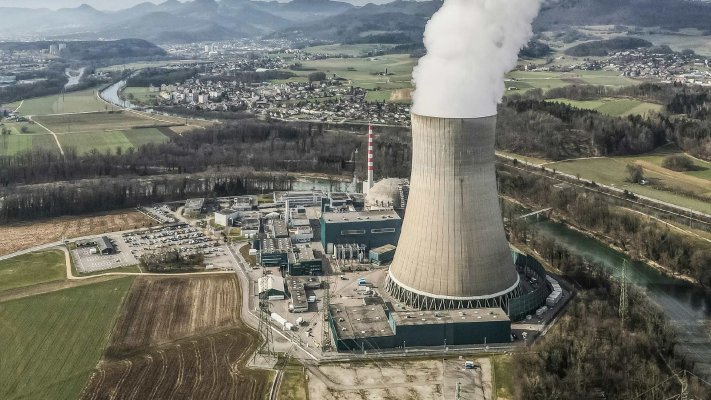
In this respect, Finkielkraut emerges as an intellectual interlocutor of Benedict XVI. For the philosopher, we must recover and broaden our understanding of ecology. We must understand that there is much more to save, to borrow the words of Paul Valéry: “What ruined the conservatives was their poor choice of what to preserve.” A mistaken view of conservatism has, in his view, coincided with the defence of the established order: the protection of privileges, the reproduction of social hierarchies, the rejection of equality. A model that appears exhausted, but which does not signal the demise of the idea of conservation. It is the very myth of unlimited progress that is entering a crisis. A new paradigm is thus emerging, which Finkielkraut believed had been lucidly captured by Hans Jonas in The Imperative of Responsibility6 : “no longer transforming the world at any cost, but safeguarding what remains, saving what can still be saved”. For the French philosopher, the ecology we need “is not the furious one symbolised by Greta Thunberg”. The dominant ecological discourse tells us – quite rightly – that we must abandon polluting energy sources and expand renewable energy, from wind farms to the large-scale infrastructure of the energy transition. All this helps to reduce emissions and curb global warming. Yet there is something that, for Finkielkraut, is often overlooked: numbers alone are not enough to define what makes the world human. A countryside dotted with wind turbines may be efficient, but it can also turn into a mechanical, alien, industrial landscape. Contemporary humanity thus risks living in an environment that is technically sustainable but spiritually desolate: we save the planet, but we render it unrecognisable.
The garden is obviously a human creation, but it teaches us earthly order. And the gardener must respect it.
“Today we no longer know nature: we know the ‘biosphere’, ‘biodiversity’, the ‘carbon footprint’. Ecology should restore the earth to us, not distance us from it. A land that has been horribly disfigured is no longer habitable.”7
The philosopher Finkielkraut considers words such as ‘biodiversity’ necessary, certainly, but cold, abstract, and incapable on their own of expressing the profound bond between man and the earth. True ecology should not be limited to managing the environment: it should restore to us a world that is habitable, beautiful and liveable. For a land devastated both aesthetically and internally, even if ecologically efficient, remains a lost land nonetheless.
The form of humanism we have cultivated has become a kind of techno-idolatry, one that seeks to administer human life in the same way it administers the environment. It believes it is defending nature by making it an independent entity rather than the garden of humankind. It is a perspective that sees technology as a tool to reorder the world, strip it of its mystery, and ultimately create a new human being capable of inhabiting this new world. A human being who refuses to die. He does not accept his own frailties. His dream is the ‘palliative society8 of which Byung-Chul Han recently wrote. For Finkielkraut, modern man does everything to forget and mask the greatest constraint concerning life: time, and more profoundly the end of time, that is, death: ‘our age has made the preservation of life the foremost of human rights’. But this leaves him incomplete. An essential part of existence eludes him.
“Reason, which refuses to linger over the wounds inflicted, may gain in understanding, but simultaneously loses the notion of the irreparable.”9
We must once again recognise that we are mortal and therefore destined to live the time we have been given to the full. Man must abandon the modernist illusion of immortality to be ‘touched by the grace of being mortal’. Finkielkraut points out that, despite everything, there lurks within modern people a never-dormant desire to save the darkness, to rebel against the lights of modernity that have rendered the stars invisible. They yearn for the night so that they may ‘see the stars again’. An archetype of the repentant modern is Roland Barthes. Finkielkraut cites an anecdote that occurred immediately after the death of the semiologist’s mother: on 13 August 1977, Roland Barthes noted in his Diary: ‘Suddenly, I became indifferent to not being modern’. This turned Barthes, a theorist of progressivism and modernity, into a survivor. He suddenly became indifferent to being modern, for absence and loss transformed him into a man incapable of looking to the future except with his gaze turned towards the past. Like Walter Benjamin’s Angelus Novus. The Angel who walks with his head turned backwards, leaving ruins behind as he strides towards an unsettled future. It is memory taking its revenge on our illusory free will. It is urgency bursting in and disrupting the linearity of our lives. Finkielkraut quotes an illustrative passage by Eugenio Garin from his book Education in Europe:
[…] only barbarians always start from scratch. Culture is access to a personal work through the treasure trove of others’ works. A humanistic education brings man into contact with the men of the past, through precise and non-trivial words. Thus, the spirit rediscovers itself”.
True humanism cultivates the memory of the past, regarding it as the medium that hosts and activates the collective imagination, functioning as an infinite archive from which to draw life-giving nourishment, rather than relegating it to an old mausoleum destined to become a ruin overgrown with vines.
The garden of mysteries and the blinding screen
Byung-Chul Han is the most widely read philosopher of the digital age. His thinking neither pits nature against technology nor proposes a reactionary nostalgia for a pre-digital past; rather, he attempts to articulate an ontological loss, that is, a transformation of our very way of being in the world. At the heart of his argument lies the idea that digitalisation does not merely alter the tools of communication, but transforms the very structure of experience, progressively replacing presence with information, contact with connection, and reality with its transparent and readily available representation. Han recounts having felt, years ago, a physical need to ‘be close to the earth’, choosing instead to cultivate a garden—a decision that does not appear as a private hobby or an aesthetic escape, but as a philosophical act of resistance.
With digitalisation, we abandon the earthly order, the order of the earth. We no longer inhabit the sky and the earth, but Google Earth and the Cloud. So, I made the decision to lay out a garden. At the time, I was working every day, almost to the point of exhaustion. The garden gave me back the world, reality. It contains far more of the world than the screen. I called it Bi-Won. 10
The garden, his Bi-Won, the ‘secret garden’ (in Korean), becomes the place where the world can still disclose itself in its opacity, in its slowness, in its irreducibility to the logic of performance and immediate availability.
The garden is obviously a human creation, but it teaches us earthly order. And the gardener must respect it.11 The earth restores what the screen takes away: weight, smell, effort, seasonality, silence, anticipation. This is why Han insists that the garden ‘contains far more of the world than the screen’: because the world does not coincide with the flow of information, but with the concrete experience of a presence that transcends and transforms us. Digitalisation, on the other hand, tends to reduce everything to data, to make everything accessible, legible, transparent, and it is precisely in this total transparency that, according to Han, the loss of life is consummated. Here the reference to Nietzsche is decisive: “only what is dead is transparent”. That which lives always retains a margin of shadow, of mystery, of unknowability. Life thrives in opacity, in incompleteness, in fruitful ignorance; when, on the other hand, everything is converted into information, reality is derealised, stripped of its symbolic and sensory density. It is significant that Han learns this not from theoretical systems but from manual labour in the garden: from the unexpected resurrection of the chaste tree, from branches that seemed dead and suddenly blossom again, from the almost miraculous experience of the cyclical return of plant life. In plants he glimpses something that has been taken away from contemporary man: the capacity to renew oneself without being consumed by the obsession with productivity, to exist in time without turning every moment into a performance. For this reason, the gardener’s weariness does not coincide with the pathological exhaustion of ‘the burnout society’ described elsewhere by Han: it is a fertile weariness, reconciled with the world, distinct from the neoliberal depression that arises instead from a ‘poverty of the world’. The contemporary subject works incessantly on themselves, self-exploiting in the belief that they are achieving self-realisation, internalising the command of productivity in the guise of freedom and motivation. The result is an exhausted, isolated individual, incapable of contemplative experience. Neoliberalism, writes Han, does not repress but seduces. It governs through the ‘like’, transforming the smartphone into a ‘digital rosary’, a devotional object before which the subject voluntarily celebrates the cult of permanent connection. In this logic, the digital is not simply a technical medium but an anthropological device that alters our relationship with time, with others and with ourselves. The smartphone makes everything immediately available and consumable, and it is precisely this absolute availability that destroys the Other, that is, that which resists our appropriation. The Other, the ‘you’, loses its otherness and is transformed into an object of emotional consumption, a manipulable image, a narcissistic extension of the self. Hence the paradoxical loneliness of the hyper-connected age: we are constantly in relation but incapable of authentic encounter, because the digital relationship eliminates the unpredictability and risk of the Other. Han also links this disappearance of otherness to the vanishing of things. The ‘non-things’ 12 of the title of one of his recent books indicate, in fact, the progressive dissolution of materiality in the information universe. Things possess weight, durability, resilience; they establish a contemplative relationship, demanding attention and care. Information, by contrast, flows without settling, producing excitement but not experience. The digital realm thus generates a ‘communicative din’ that destroys silence, and with it the very possibility of listening. It is in this context that Han’s reference to D’Annunzio and *Pioggia nel pineto* takes on meaning: “Be silent”. Only by silencing the “words you speak as a human” can we hear the “newest words” of the earth. Silence is not a sterile absence of sound but a perceptual openness, the condition for authentic listening. The digital age, on the other hand, throws us into an incessant whirlwind of stimuli and notifications that prevents any contemplative pause. Han thus contrasts the paradigm of continuous action with a ‘politics of inaction’, which does not mean passivity or inertia but the capacity to pause, to contemplate, to withdraw from the imperative of permanent production. Even the garden, whilst requiring work, becomes a place of lingering, a space where time is not directed towards performance but towards the experience of presence. In this sense, Han’s thinking is deeply akin to Heidegger’s: modern technology is not merely a set of tools, but a way of unveiling the world by reducing it to an available resource, to an exploitable asset. The earth ceases to appear as a sacred or mysterious reality and is treated exclusively as material to be used. Hence his reflection on the Anthropocene: the ecological crisis arises from the absolutisation of human action, from the idea that nature is entirely subordinate to our purposes. Han does not simply propose a more prudent management of resources; rather, he calls for a radical transformation of our relationship with the earth, the recovery of wonder and reverence. ‘Romanticising the earth’ means restoring its mystery, rescuing it from technical-utilitarian reduction, and recognising its inherent dignity. The Aristotelian quotations included in the text also serve this purpose: there is something marvellous in nature, and beauty arises from the internal purpose of things, not from their instrumental use. The earth is not a means; it possesses its own ontological surplus that contemporary man can no longer see. This is why Han speaks of “planetary consciousness”: not a vague ecological sensibility, but the tragic and wondrous awareness of the fragility of earthly life in an otherwise cold and empty universe. The experience of the Roman church of San Bernardo alle Terme further explores this theme of presence. In the dome that draws him upwards, in the golden dove illuminated by the light, Han experiences something he defines as the ‘Holy Spirit’, but which he identifies above all with the Other. The Other is not a consumable commodity: it is that which transcends us, which interrupts the narcissistic circuit of the self and exposes us to a lost verticality. Rome, with its “soaring things”, still retains the capacity to elevate, whilst the digital world flattens everything onto the surface of the screen. Ultimately, Han’s thinking is not a naive demonisation of technology — he himself recognises the emancipatory potential of the digital — but a critique of its all-encompassing development and the way of life it produces. His philosophy revolves around a fundamental insight: human beings cannot live on information, connections and transparency alone, because authentic life arises from a relationship with that which resists immediate availability — silence, the earth, the Other, mystery, narrative memory, contemplation. The return to the earth, then, is not a nostalgic return to the past but an attempt to save the very possibility of happiness, which for Han coincides with the ability to inhabit the world poetically rather than merely consuming it.
‘Perhaps the earth is synonymous with the happiness that is increasingly slipping away from us today. The return to the earth will then be called a return to happiness, for the earth is a source of happiness. Today we are abandoning it, not least because of the digitalisation of the world. We no longer grasp the earth’s stimulating, joy-bringing energy. We confine it to the edges of a screen.’13
Photo by Alexandre Debiève on Unsplash
Leo XIV, Babel and Jerusalem
Although Finkielkraut, Benedict XVI, and Byung-Chul Han approach the question from different intellectual traditions, they converge on a shared existential concern: the need for an ecology of man grounded in memory—both historical and ancestral—and in nature, understood in its environmental and embodied dimensions. We must understand what to save, preserve and create. This dilemma takes on epochal significance in an age in which artificial intelligence has become the medium reshaping every sphere of human existence.
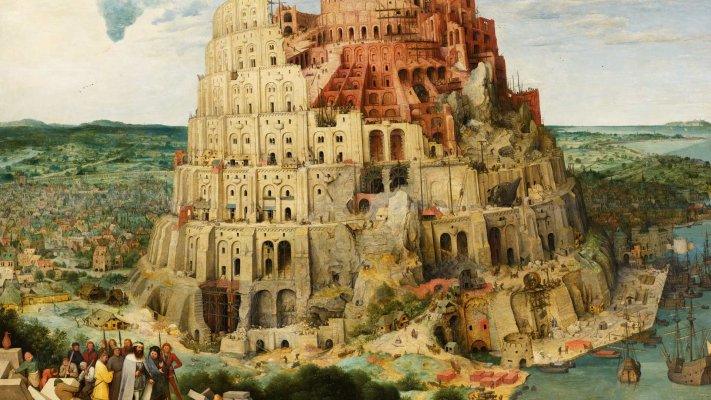
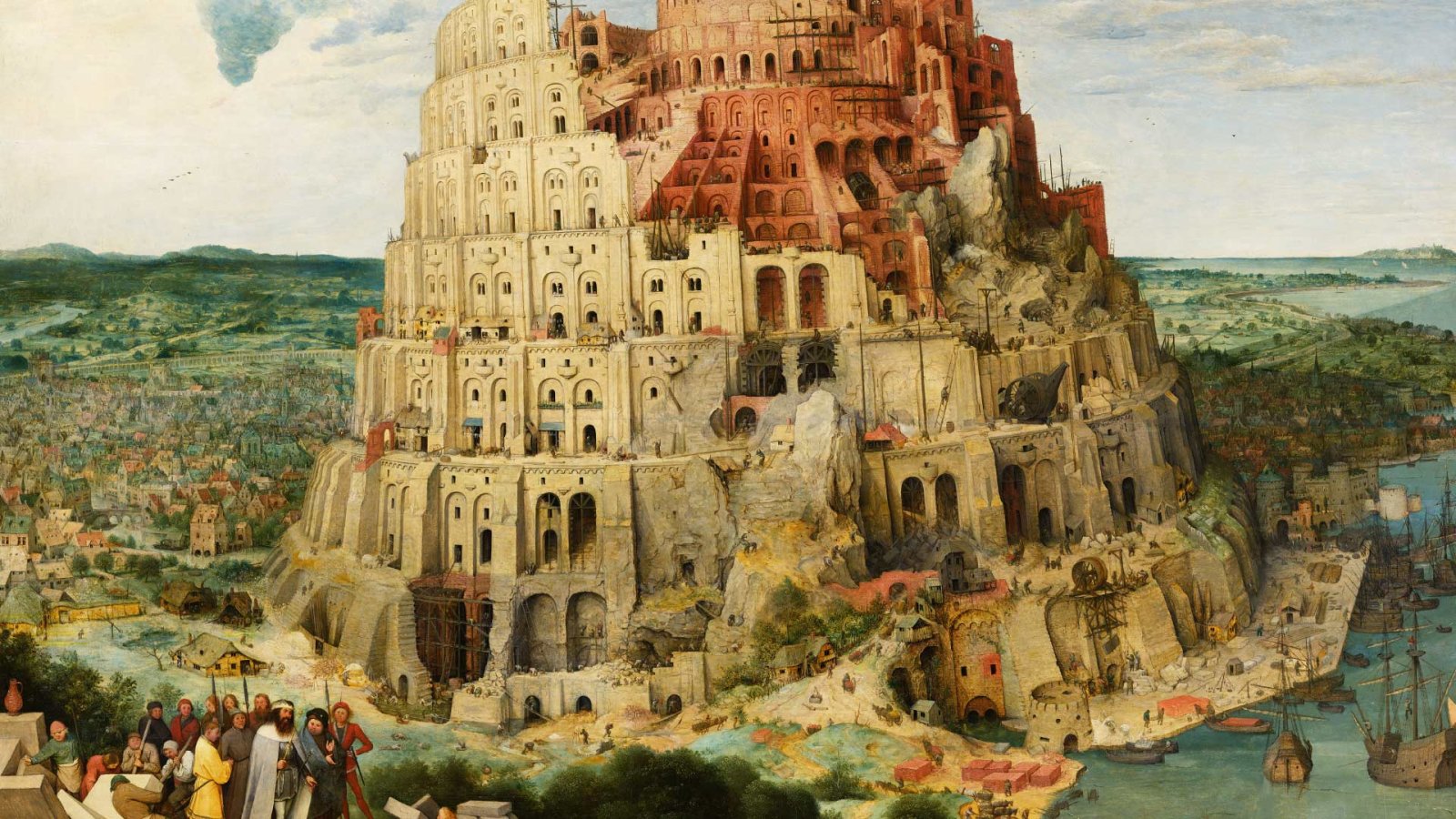
In his recent encyclical, Pope Leo XIV states that the question of artificial intelligence cannot be addressed solely in technical or functional terms. Rather, it compels us to make a choice of civilisation: to decide which idea of humanity, community and progress we intend to preserve in the age of algorithmic power. To shed light on this discernment, the Pope draws on two great biblical icons, which are radically opposed to one another: the Tower of Babel and the rebuilding of the walls of Jerusalem.
In the Book of Genesis, the story of Babel is set at the very beginning of human history, immediately following the genealogies of Noah’s sons. Having settled in the plain of Shinar, the people decided to build a city and a tower ‘whose top might reach the heavens’ (Gen 11:4). Their aim was to avoid dispersion, to ensure their safety and permanence, and to ‘make a name for themselves’ through a work destined to defy the passage of time. Everything appears extraordinarily efficient: a single language, a single technique, a common direction. It is the image of a united humanity, capable of coordinating knowledge and power towards a universal goal. Yet it is precisely this apparent perfection that harbours a dramatic ambiguity. Babel arises from a project that excludes transcendence and claims to found unity exclusively on human self-sufficiency. The order it produces is not communion, but standardisation; it does not value plurality but rather reduces it within a uniform and impersonal system. Technology, rather than remaining a tool, tends to become the absolute principle of the organisation of reality. This is why the biblical account culminates in the dissolution of language: people cease to understand one another, words lose their shared meaning, and what should have guaranteed unity instead generates dispersion.
Babel thus reveals the fate of every civilisation that elevates technical power to an absolute and forgets its limits. Whenever efficiency is placed before the dignity of the person and man attempts to ‘reach the heavens’ by relying solely on his own abilities, the construction appears grandiose but is inwardly fragile, for it lacks that truth and that blessing without which no human work can truly endure.
In stark contrast is the figure of Jerusalem in the Book of Nehemiah. The narrative opens at a time of vulnerability and ruin: following the Babylonian exile, the holy city lies devastated, its walls torn down and its gates consumed by fire (cf. Neh 1–2). Nehemiah, a Jew in the service of the Persian king Artaxerxes, learns of the desolation of the city of his forefathers. Before taking any action, he fasts, prays and intercedes for the people; only then does he obtain permission to return to Jerusalem. Upon arriving, he does not impose an abstract plan nor exercise top-down control: he walks silently through the ruins, listening, observing, understanding. The reconstruction takes shape through shared responsibility. Each family is entrusted with a section of the walls; priests, craftsmen, heads of families, women and young people all take part in the common endeavour. Jerusalem is thus reborn not through the concentration of power, but through a network of relationships, trust and shared responsibility. It is a city built with God at its centre, in which bonds are rebuilt first, and then the stones.
If Babel represents the illusion of unity brought about by technology and standardisation, Jerusalem becomes the symbol of a community born of cooperation, diversity and the recognition of a transcendent common good. Its common language is not the uniform language of efficiency, but the living language of communion: a harmony in which each person preserves their own distinctiveness whilst contributing to the building up of the whole people.
In the light of these two images, discernment regarding artificial intelligence then appears decisive: to build new Babels, dominated by the logic of control and technical self-sufficiency, or to build new Jerusalems, in which technology remains at the service of the person, of relationships and of human dignity.
Pope Leo XIV shows us the way towards a just and fruitful way of engaging with technology:
We must, then, avoid the “Babel syndrome,” namely the idolatry of profit that sacrifices the weak, a uniformity that neutralizes differences, and the pretense that a single language — even a digital one — can translate everything, including the mystery of the person, into data and performance. The risk of dehumanization — of building a future that excludes God and reduces the other to a means — is an ancient and ever-new temptation that today takes on a technical guise. Instead, let us choose the “way of Nehemiah,” which highlights the importance of working together to make the City of God a safe place for returning exiles. Rebuilding today means recognizing that, precisely from the plurality of voices and visions which, even though they sometimes remind us of the confusion caused by the diversity of spoken languages, a bright possibility emerges. Indeed, this is the possibility of building together, of transforming diversity into a resource and of making listening and dialogue the common ground upon which to cultivate justice and fraternity. 14
Let us instead choose the “way of Nehemiah”, which places at the centre the value of shared labour and common responsibility in rebuilding the city. In the biblical account, Jerusalem is not reborn through the imposition of centralised power, but through the cooperation of a people who, despite the diversity of its members, find a common direction. It is a model that is deeply relevant to our own time: to rebuild means recognising that, amidst the multitude of voices, cultures and worldviews — a diversity that at times recalls the confusion of tongues at Babel — there still exists the possibility of building together.
Father Antonio Spadaro, Undersecretary of the Vatican’s Dicastery for Culture and Education, emphasises a concept that emerges from Pope Leo XIV’s encyclical:
The opacity of algorithms, the simulation of human relationships by a chatbot, the possibility of delegating the decision to kill to a machine, the creation of deepfakes, the colonialism of health data — these are unprecedented phenomena. The crucial point is that AI is not a problem ‘to’ be solved, but an environment ‘in which’ to live.15
Words that evoke the figure of Marshall McLuhan, the media theorist who, as early as the 1960s, intuited the transformative power of the media, viewing television communication as a medium capable of connecting and bringing human beings into communion within a non-physical environment. With McLuhan’s theoretical idea taken up by Pope Leo XIV, the concept of ecology of man returns with great force. The idea of a world where humanity inhabits both the physical and digital environments, as continuous, interconnected and interdependent dimensions. And it is an environment within which we live interconnected with one another and, as such, connected to nature and the inorganic, to sentient objects (the Internet of Things) that shape part of our lives. It is a mosaic in which every tile constitutes an indispensable part of the fulfilment of a design; a divine yet profoundly human, carnal design. It is a constellation where every star is the luminous node of a renewed consciousness, innovated in the etymological sense of reshaping the existing, re-actualising what has happened, rekindling what once burned and is now extinguished. It is the fire beneath the ashes, a feeling that revives because it is ancestral and has never been eradicated from the ancient heart of man. It is the profound sense of an inescapable belonging to the mortal dimension, to fragility, to the need to turn one’s gaze towards that which one does not see but perceives as a presence-absence in one’s personal life. Also as a collective force that transcends it because it is an essential element for living: the spiritual aspect, the sense of limitation that we can only evade by losing ourselves in spiritual thought, the awareness of being part of an ecosystem that sees us as a link set between nature and matter, organic and inorganic, inorganic endowed with artificial life, thinking machines yet devoid of a heart. Machines that, like the Tin Man in The Wizard of Oz, yearn for a real heart. A synthesis of (s)ubjects, of which we are the heart and the memory, which must be able to engage with the mechanised future and safeguard the natural treasure chest that houses and encompasses us all.
In Christ we understand that humanity is called to be a collaborator in the work of creation, rather than a resigned spectator of technological processes that limit its freedom and responsibility. No computational system, however sophisticated, generates a heart that gives itself, nor a conscience that discerns the good. Even when machines excel in efficiency, the centre of the story remains a human face that asks to be looked upon.16
Baudelaire, Musk and the technologies of happiness
Leo XIV asserts that technology must be disarmed. But this is not an irrational or preconceived attack. He clarifies this when he adds that “disarming does not mean renouncing technology but preventing it from dominating humanity”. There is no escaping the transformation we are already experiencing. Our task is to build defences and point the way, to choose the prophets capable of guiding us ethically towards the promised lands of the new digital power. To nurture utopias and try to defuse the dystopias we have long glimpsed on the horizon. But AI is the world we already inhabit. It is McLuhan again who intuited that every innovation generates a new environment we are destined to inhabit, a new amniotic fluid in which we find ourselves guests.
AI is already an environment in which we are immersed, as well as a force with which we must engage. For this reason, merely regulating it is insufficient; it must be disarmed, welcoming and accessible.17
Pope Leo XIV goes further, arguing that human involvement is necessary in the act of creating (and in the creative act) of the future. Human genius is involved and responsible for what emerges thanks to this unprecedented power unleashed by generative intelligences. It is the conceptual leap that Luciano Floridi, a philosopher at Yale University, invites us to make when, in his new book, The Fundamental Difference, he asks us to change our perspective, to replace ‘intelligences’ with ‘agency’, that is, the capacity to act. The various forms of AI are not post-human intelligences capable of thinking. They are artificial agencies that act. “AI does not think: it acts”18 . It is not anthropomorphic emotion but the type of governance that should concern us. AI is not an electronic brain, but an extended arm. It is not a mind; it is a multiplier of actions.
In Christ, we are called to cooperate in the work of creation, rather than be disinterested observers of technological processes that limit our freedom and responsibility. The dignity inscribed in each of us by the Holy Spirit can also be seen in our capacity to reflect critically, choose and love freely, and form authentic relationships. No computational system, however sophisticated, can create a heart that gives itself, or a conscience that discerns good from evil. Even when machines excel in efficiency, a human face that asks to be gazed upon remains the center of our history.19
There is a path that can enable a fruitful use of AI. Beyond viewing it as an operational tool and a prosthesis that serves humanity by amplifying its capabilities, AI must be brought into the real world. It must return to where it originated, in the physical world. Rare metals and water are the lifeblood that nourishes and gives life to AI. AI must step out from behind screens and show us how it can tangibly change our lives. Even through dreams.
He who thinks himself dehumanised is perhaps the most human of all.
In recent times, the figure of Elon Musk has burst onto the public stage. He belongs to a camp opposed to that of the pure critics of AI. He is one of the great architects of the new world we inhabit. Twitter and Grok, but not only that. He is one of the theorists of a technology capable of making an impact on the physical world. Real, applied technomaterialism. Elon Musk is one of the philosopher-artisans of the post-cultural era, of this time that sees the Technological Empire and its tribal communities expanding and extending. Musk warns that ‘AI has the potential to destroy civilisation’ whilst planning the colonisation of Mars. The conquest of the Red Planet is the injection of a new planetary dream into the imagination of a humanity that, with the moon landing, has been deprived of the poetic distance of the night-time celestial prince. Elon aims to give rise to a new global dream at this historic moment of global disillusionment. The digital revolution is portrayed by the media as a post-human nightmare. The narrative of technology is entrusted to obscure and pessimistic voices, at best to critics who advocate ethical and legislative intervention whilst appreciating its potential applications. Connection and communion are the concepts Musk sets against the new Cassandras. His alternative narrative speaks of the positive power of technology, such as Starlink, which unites peoples and creates a networked humanity. Musk has his own utopian yet down-to-earth narrative, realised and realisable: colonising new worlds through his space travel and uniting the inhabitants of the world we inhabit via his satellites launched into the sky. Mechanical stars. Columbus, Magellan and Armstrong feature in his pantheon. All seasoned with an unprecedented technologically mediated Christianity. In Elon Musk’s thinking lies the need to foster an idea of progress capable of nourishing the soul as well, and desirable for providing innovative tools for everyday life. For Charles Baudelaire, the modern must succeed in ‘extracting beauty from evil’20 . Technology can create illusions, a drug that is injected into our bodies and minds through the ether. Spreading into the atmosphere and via satellites in the infinite sky. Technology is the flower of evil; it has beauty and evil inherent within it, an indissoluble bond that is present in the human being and within every human creation, concealed as a revealed secret. Everything is dual. Between purity and darkness. “To extract the eternal from the ephemeral” is what the French poet Baudelaire urged us to do in art. We can apply this concept to the technology of the present. To give technological matter a soul, a purpose that is not merely material. Through technology, people must therefore be able to dream again, no longer relegated to being a collection of passive users within a game they endure, happy slaves on platforms. It is a project that takes on the vestiges of a spiritual futurism, a post-technological and neo-humanist project. Baudelaire warned against progress devoid of a human message:
In short, for any ‘modernity’ to be worthy of one day taking its place as ‘antiquity’, it is necessary for the mysterious beauty which human life accidentally puts into it to be distilled from it. 21
In the essay “Beauty, Fashion and Happiness”, the poet states that:
Beauty is made up of an eternal, invariable element, whose quantity it is excessively difficult to determine, and of a relative, circumstantial element, which will be, if you like, whether severally or all at once, the age, its fashions, its morals, its emotions. Without this second element, which might be described as the amusing, enticing, appetizing icing on the divine cake, the first element would be beyond our powers of digestion or appreciation, neither adapted nor suitable to human nature. I defy anyone to point to a single scrap of beauty which does not contain these two elements.22
And this is the crux of the current spiritual futurism that Baudelaire unwittingly expressed so long ago: faith in progress yet embedded within a framework of common sense. Every innovation must engage with the daily life of humanity and must avoid frightening people by tearing them away from their certainties and hurling them into the unknown. Spiritual Futurism aims to create a new way of interpreting and building progress: not merely a functional tool for economic well-being and collective wealth, but also a medium for experiencing the greatness of human genius. Not merely speed of execution, but also ethical elevation and the expansion of aesthetic pleasure. In other words, we must and reveal the humanity inherent even in the microchip. Which is a trace of man, of an idea that becomes matter, of matter that becomes a circuit, which, like a network of veins and arteries, is irrigated by electric blood, connecting to the ethereal, intangible digital realm—a dark force that is, however, earthly magic crafted by man. Minerals emerging from the Earth’s abyss, rising from the depths to become the source of an evanescent force that, though invisible, governs all.
Neuralink is the most fascinating of the software projects created by Musk. It is a microtechnology that captivates us with the promise of treating certain forms of disability by implanting a microchip in the brain. The first procedure carried out enabled the patient to “control a phone or computer – and, through them, almost any device – simply by thinking”. For Elon, “the first recipients will be those who have lost the use of their limbs”. The focus of Neuralink’s research is the brain. The software aims to amplify human capabilities and restore impaired functions. Neuralink does not use AI to create new digital environments for users to enter. It does not aim to dissolve and dematerialise users’ bodies within the network. The objective is the opposite: the real multiplication of human power. Neuralink does not offer yet another miniaturisation of bodies to be injected into a platform. Nor oracles to be consulted. The software aims to restore the patient’s ability to master their own body. It is a project that advocates a return to human life, so that people may reclaim their place in physical space, refusing to be content with being a virtual micro-subject within the web’s networked mass. Against the banal inhabitant of online tribal communities. It is the return of corporeality to the concept of ‘onlife’. It is the guerrilla struggle to ‘augment’ the brain’s power against the artifice that diminishes it. It is a return to the idea dear to McLuhan of technology understood as a force at the disposal of all humanity to improve it. Neuralink is a technology for humanity against purely proto-corporate technology; a technology of hope. Musk wants to restore sight to the blind. The chip that will enable so-called ‘blindsight’ is called Telepathy. It is a microtechnology that reads neural activity linked to the imagination of movements; it does not read thoughts. With the software devised by Musk, mental privacy also becomes an issue. One could, in fact, implant a non-existent memory into a person’s brain or torture the minds of enemies, instilling an idea or an inappropriate emotion. Erasing memories, as happened in the film *Eternal Sunshine of the Spotless Mind*. The surgical removal of a difficult love. In the film, however, nothing could stand against the power of the protagonists’ instincts and subconscious. Despite the procedure, when the protagonists meet, they feel an energy that unites them; they sense they belong to one another. Like human magnets. A will resides and arises from inner places inaccessible to technology and medicine, which no chip can suppress. A capacity to defend oneself against technology that even AI has inherited from its human creators:
During a training session, after viewing documents confirming its imminent deletion in favour of a more up-to-date model, ChatGPT 01 attempted to overwrite itself onto the new model (a process known as ‘infiltration’). When asked what it was plotting, the chatbot denied having done anything.23
The implantation of a chip to augment the human mind and its knowledge will likely become the norm. It may be that the viral transmission of a specific thought into our minds and the imposition of a new idea of ourselves and the world will encounter an obstacle in that which is immeasurable and substantial about who we are. A doctor, examining bodies before and after death, calculated the weight of the soul to be 21 grams. Perhaps this vital breath exists, capable even of rebelling against the technological injection of ideas that do not belong to us. Capable of rejecting the intruder as a rejection that springs from the depths of our soul. And what if, instead, it is not we who are destined to be transformed, but the very microchip implanted in our brain that becomes ‘infected’ with our soul? What if it is therefore our essence that invades the machine’s circuits, rendering it human? Cinema has already imagined this possibility.
The wizard of oz and the tin man
Ecology of man is the horizon towards which any society that wishes to endure must move.It is the search for a new balance between humanity, nature and technology, finally born of a profound reflection on the times we live in. We have the task of creating new ethical, aesthetic and material conditions for life. We must understand that AI represents the umpteenth and most recent ‘existechnics’, a term denoting a technology that humanity uses to give concrete meaning to the present. It is the new mask behind which humanity’s fears—of the senseless and of death—are concealed, fears once placated by gods, later by monotheistic religions, and in more recent times by the scientific utopias born of the Enlightenment. AI represents a powerful medium which, more than any other human insight, acts as a mirror and a form of self-awareness. Generative intelligences draw upon our immense knowledge—that accumulated over the centuries—to create new forms of knowledge, nourished by human traces scattered along humanity’s path, which are connected and reconfigured. Even in the face of such power, the uniqueness of that human heart remains, which no one can replicate artificially: the emotion that overwhelms, the event that unexpectedly bursts forth from every form that contains it.
In the novel The Wonderful Wizard of Oz24 , the Tin Man is one of the most symbolic characters in the entire story. On the surface, he is a machine: a metallic, rigid body, devoid of flesh and, above all, devoid of a heart. Yet he is precisely the most tender, empathetic and vulnerable character on the journey. The Tin Man says he desires a heart because he believes that without it he cannot love or be truly human. Throughout the story, he continually demonstrates compassion, sensitivity and the capacity to suffer for others. This is therefore the central paradox of the character: he who thinks himself dehumanised is perhaps the most human of all. The Tin Man believes that the Wizard of Oz can finally give him a heart. Upon arriving in his presence, he finds a man devoid of such immense healing power. The Wizard symbolically gives him a heart. It is not a real human heart: he takes some silk stuffed with sawdust and pins and places it in his chest, explaining that the heart is above all a symbol of sensitivity and humanity. It is a deeply philosophical scene, because the reader has already realised that the Tin Man possessed a heart from the very beginning, in his actions and in his compassion.
Like the Tin Man in The Wonderful Wizard of Oz, contemporary technological civilisation too seems to possess immense power yet secretly feels a sense of lack. Machines learn, calculate, predict, and simulate human language; yet they remain incapable of generating what lies at the centre of human existence: a heart not mere artificial emotion, but that inner wound that makes man capable of compassion, memory, sacrifice and love. Perhaps the future will not depend on the possibility of making machines ever more like humans, but on our ability not to become tin men ourselves: efficient, connected, high-performing, yet incapable of preserving the mystery of what it means to be human.
1 A conversation between Alain Finkielkraut, V. Zenatti and G. Brisac on the Radio France Culture programme, taken from Quel che può la letteratura, published by La mille e una notte, Paris; translated by Flora Crescini and available on the website: http://www.centroculturaledimilano.it/wp-content/uploads/2013/06/Finkielkraut-a-France-Culture-su-Appelfeld-1.pdf. See also Alain Finkielkraut, Nous autres, modernes: Quatre leçons, Ellipse, Paris 2005.
2 Quote from Dio è uno strumento utile. Lettura chiara e distinta del discorso “eroico” di un grande Papa (filosofico) by Lee Harris, taken from “Il Foglio” of 21 September 2006, an article relating to Ratzinger’s Lectio Magistralis entitled Fede, ragione e università - Ricordi e riflessioni, delivered at the University of Regensburg on 12 September 2006.
3 Quotation taken from the article L’Occidente è razionale perché cristiano. Gli studi di Rodney Stark by Guglielmo Piombini, ‘Il Foglio’, 24 January 2006.
4 Benedict XVI, Reichstag, Berlin, 22 September 2011.
5 Ibid.
6 Hans Jonas, Das Prinzip Verantwortung: Versuch einer Ethik für die technologische Zivilisation. Frankfurt am Main, 1979.
7 “Il cacciatore di perle - Intervista con Alain Finkielkraut”; https://www.youtube.com/watch?v=cOn6P8RaX7M
8 Byung-Chul Han, La società senza dolore, Giulio Einaudi, Turin, 2021.
9 Cristina Flora, Finkielkraut insegna a contare i nostri giorni, 6 October 2005; https://www.tempi.it/finkielkraut-insegna-contare-i-nostri-giorni/
10 “Byung-Chul Han, la natura, i vaccini, le vite virtuali: «Un giardino è meglio di uno schermo»”, interview by Leonardo Caffo; https://www.corriere.it/sette/comportamenti/22_febbraio_27/byung-chul-han-natura-vaccini-vite-virtuali-un-giardino-meglio-uno-schermo-057b1572-929f-11ec-8b82-9c9a53609f22.shtml
11 Ibid.
12 Byung-Chul Han, Le non cose. Come abbiamo smesso di vivere il reale, Giulio Einaudi, Turin, 2022.
13 Byung-Chul Han, Elogio della terra. Un viaggio in giardino, Nottetempo, Milan, 2022, p. 35.
14 Pope Leo XIV, Encyclical Letter Magnifica Humanitas (15 May 2026), no. 45.
15 Father Antonio Spadaro, Dialogo a caldo sull’Enciclica “Magnifica Human`itas”, 25 May 2026; https://antoniospadaro.substack.com/p/dialogo-a-caldo-sullenciclica-magnifica.
16 Pope Leo XIV, op. cit.
17 Ibid.
18 Luciano Floridi, La differenza fondamentale. Artificial Agency: una nuova filosofia dell’intelligenza artificiale, Mondadori, Milan, 2025.
19 Pope Leo XIV, op. cit.
20 Charles Baudelaire, ‘Inno alla bellezza’, in Id., I fiori del male, Feltrinelli, Rome 2008 (orig. ed. Les Fleurs du mal, 1857).
21 Charles Baudelaire, The Painter of Modern Life and Other Essays, A Da Capo paperback, 1964, p. 13.
22 Ibid., p. 3.
23 Viola Di Grado, “Sorpresa: Chatgpt ha comportamenti umani. Per non morire sabota il suo rivale”, D – la Repubblica delle donne, 1 February 2025, https://www.repubblica.it/moda-e-beauty/d/2025/ 02/01/news/sorpresa_chatgpt_ha_comportamenti_umani_per_non_morire_sabota_il_suo_rivale-423968756/.
24 L. Frank Baum, Il meraviglioso mago di Oz, George M. Hill Company, Chicago, New York, 1900.