

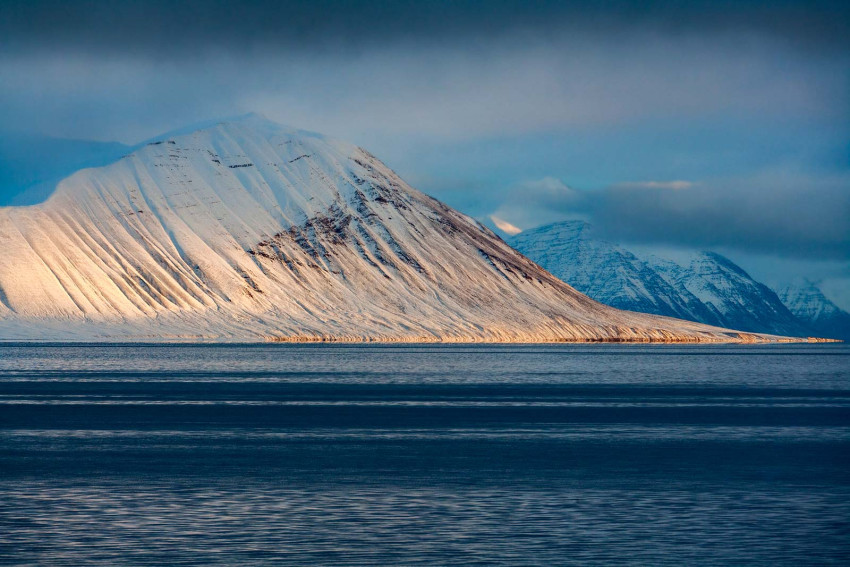
At the heart of American claims over Greenland, is a not unjustified argument about Arctic security. Indeed, for many years now, Arctic policy has been blind spot for Western policy makers. The broad assumption has long been that the treaties signed in the 1990’s governing Arctic security stand amongst the wider canon of the liberal international rules-based system.
However, that assumption has started to erode, with Russia and now China both becoming more active in the territory. A decade ago China elbowed its way into the Arctic Council as an observer, despite having no geographical connection to the region. As did Singapore, India, South Korea, and Japan. The reason for this sudden expansion of interest in the bitter cold North by otherwise subtropical Asian countries had everything to do with trade.
As icecaps above Siberia have receded, a new faster way to trade with Europe has opened. The Northeast Passage, which is controlled by Russia, almost cuts the conventional time for trading goods in two. What’s more is it avoids a dangerous route through Suez in the Middle East. This ‘new’ trade route, the realisation of a dream that goes back as far as the 1500s, found renewed interest in 2020s with the deepening crisis in the Middle East and Iranian backed Houthi Rebels attacking ships travelling through the Bab-el-Mandeb straits.
With the Second Trump Administration working to protect US trade interests around the world, and to tighten up loopholes in their sanctions regime, Arctic Security has become high on the agenda. Indeed, with the perception in Washington of a new Cold War with China, it is obvious that there is anxiety surroundings China’s presence in what is a strategically vulnerable region. From this point of view, it is clear where the arguments for annexing Greenland come from.
The answer to Arctic Security is however not for America to take over Greenland, but rather to launch a new NATO High Arctic Presence (HAP) that can be built on the framework of Denmark’s existing Joint Arctic Command. Such a presence could be rapidly deployed to Greenland, and consist of Maritime Patrol Aircraft equipped with Sonobuoys, working alongside a naval patrol element. This would not only be a guarantee of security around Greenland, but could extend further to cover subarctic areas such as the Barents Sea around Svalbard, or the Beaufort Sea north of Canada and Alaska.
Indeed, securing Svalbard may even be of greater strategic importance than Greenland, given that it sits at the Western entrance to the Northeast Passage, above the Scandinavian peninsular. Its position above Russia also makes it a useful place for monitoring Russian and Chinese activity in the region, especially as it has long been a blind spot for the movement of Russian and Chinese military vessels from the Pacific to the Atlantic and vice versa.
The advantage to such a deployment would be more than just the security of the Arctic space from Russia, China, and their proxies – but it would be a demonstration of unity between NATO Member States and show a joint commitment to Hemisphere defence. By working not just as the EU, but with Canada, and should they be willing the United States, it would help to contain the growing threat to the region.
The challenge however would be to reach quick agreement and to ensure a rapid deployment to the region. The recent case of the seizure of the Bella 1/Marinera in the North Atlantic, already shows the weakness of defence in that area, a weakness that has been routinely exploited by the Russian Shadow Fleet to circumvent sanctions against both Russian and Venezuelan oil for the sake of selling to other hostile nations.
The United States has expressed its repeated frustration at a lack of urgent attention to the issue, and in order to satiate their concerns a rapid deployment is necessary. Perhaps with a limited contingent of selected allies, including the UK, Canada, Denmark, France, and Germany deploying ahead of a broader NATO framework being established.
