

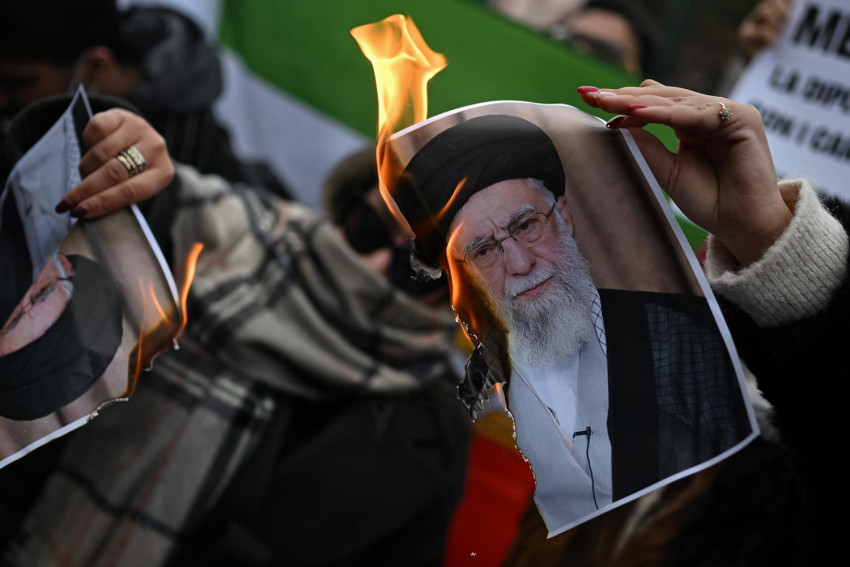
The situation in the Gulf has been evolving rapidly ever since the launch of US-Israeli strikes on Iran on 28 February 2026, followed by Tehran’s large-scale drone and missile attacks on the Gulf Cooperation Council (GCC) countries as well as Jordan, Iraq, Israel, Cyprus (an EU member) and Türkiye (a NATO member).[1] The US and Israel have been explicit about the fact that one of the objectives is to facilitate regime change in Iran. The situation was widely seen as ripe for escalation following the gradual weakening of the Islamic Republic, with unprecedented blows to its regional proxy network since October 2023 and mounting domestic discontent driven by violent repression and deteriorating economic conditions. In recent months, there have also been more visible efforts to unify and strengthen the Iranian opposition that could provide a viable plan for political transition—Reza Pahlavi’s appearance at the Munich Security Conference on 13 February is a case in point. The killing of Iran’s long-time Supreme Leader Ali Khamenei in the US-Israeli strikes on 28 February has intensified the regime change debate, including in Europe. The European Parliament, for instance, is considering inviting various key figures from the Iranian opposition.[2] Given the rapid pace of developments and the explicit regime change objectives of the US-Israeli strikes, it is important to assess the potential next steps and regional implications of a potential collapse of the Islamic Republic.
Regime change seldom happens with air operations alone and requires a ground component to be successful. However, it is much more difficult to gain superiority during ground operations – as evident in Iraq, for example – which further increases uncertainty about how the conflict will end. Nevertheless, three main developments could help indicate a potential direction:
There seems to be a widespread domestic public hostility towards the regime after 47 years of repression and disenfranchisement. Over the years the internal pressure has steadily increased, as manifested by repeated waves of demonstrations in recent years that were violently suppressed by the regime’s security forces, including the Basij and the Islamic Revolutionary Guard Corps (IRGC), which were recently added to the EU’s terror list.[3] The most recent and widespread anti-government protests erupted in late December 2025, bringing large parts of Iranian society to the streets. The suppression of these protests by the regime has claimed thousands of lives.[4]
Demographically, Iran is a diverse and splintered country, with numerous sizeable ethnic groups making up its 93 million population, including Persian, Azeri, Kurdish, Lur, Balochi, Ahwazi Arab and Turkmen.[5] In this context, regions with active separatist movements, particularly Balochistan, Khuzestan and Kurdistan, could become important pressure points.
Emerging indications of the US supporting insurrection of Kurdish forces on the ground point to efforts to use local actors to launch a ground offensive against the regime’s security forces and facilitate regime change.[6] Although the Kurds are unlikely to lead a country-wide offensive against the government, it could inspire other militias to be formed among the other minorities in other parts of the country. Numerous external actors could seek to exploit those insurgencies. Nevertheless, those militias would face strong resistance from the Islamic Republic’s forces. The regime has developed a dual military structure due to the separation between the IRGC and the national army, maintaining parallel naval, air, intelligence and cyber capabilities. Internal splits could emerge within both, with some high-ranking members joining the opposition. However, the IRGC is more ideologically indoctrinated as its primary purpose is to protect the Islamic Revolution and its achievements both at home and abroad.[7] In the face of regime collapse, the IRGC may resort to extreme violence in a bid to preserve the system or retain a degree of control.
The Islamic Republic is therefore confronted with a potentially lethal combination of a broken domestic scene, foreign superior airpower and local ground offensive. Possible medium to long-term regional implications include the demise of the Islamic Republic of Iran but also the creation of a fragmented state highly susceptible to external influence and competing interests. This does not necessarily mean that it would replicate the post-2003 Iraqi trajectory, but it would likely create new incentives for external actors to shape Iran’s stability during a leadership transition. In this context, the role of the United States, the GCC and key European allies would be crucial in shaping the transition and preventing rival external powers from gaining a strategic advantage during a potential reconfiguration.
Despite the bleak outlook, there is a scope for a stable and secure Iran that could contribute to a broader regional security architecture once the theocratic regime is removed and external interests are tempered. Achieving this outcome, however, would be a long and complicated process.
The removal of the Islamic regime in Tehran would certainly not be mourned on the other side of the Gulf. The Islamic Republic has spent over four decades building clandestine networks and arming proxy militias across the region under the supervision of the IRGC and its Quds Force. Yet, the GCC countries are also acutely aware of the associated security repercussions and will do their utmost to try to insulate themselves from the fall-out.[8] This is particularly relevant when looking at Bahrain, Kuwait and Saudi Arabia, where the Islamic Republic has a long history of interference, assassinations and bombings—notwithstanding the latest, most intense round. The GCC countries have faced numerous difficulties while dealing with such insurgencies in the past, but now, more than ever, they will devote all necessary resources to contain such risks. For instance, since 28 February, Bahrain significantly reinforced police presence and made several arrests due to concerns over Iran-backed efforts to undermine the Kingdom’s stability from within just as it faces Iran’s aerial assault.[9] Islamic Republic-sympathetic local groups have recently sought to exploit the situation and started violent demonstrations, including throwing Molotov cocktails.[10]
While GCC states are wary of the potential instability associated with regime change, should it occur, they would ultimately favour the emergence of a prosperous Iran that refrains from interfering in their internal affairs and respects their sovereignty. Any future government that would adhere to those principles—not only rhetorically but also in practice—would represent a welcome change from the GCC perspective. The region, however, does not consist only of the GCC countries and the repercussions would significantly affect other key actors in the region as well, with Iraq, Syria and Yemen emerging as the principal flashpoints.
Iraq has been fractured since the 2003 US-led Operation Iraqi Freedom that toppled Saddam Hussein and opened the door for the Islamic Republic of Iran to become a key powerbroker across much of the country. Given the depth of Iranian influence in Iraq, its collapse could trigger renewed internal conflict in Iraq and fragment the Popular Mobilisation Units (PMU). Iran-backed groups such as Kataib Hezbollah, Asaib Ahl Al-Haq and others from the PMU could also launch attacks aimed at punishing the countries around Iraq. In such a scenario, the border areas with Jordan, Syria and Türkiye would be of particular concern.
Syria, which is in a fragile phase of a post-Assad internal consolidation, could again become a battleground for the fight between Iran-backed militias and the Gulf- and Türkiye-backed groups as well as the Syrian Army.
In Yemen, by contrast, the Houthis (Ansar Allah) are less likely to get seriously involved. Having consolidated control over significant parts of Yemen’s territory, they are more likely to prioritise internal consolidation over costly external adventurism that could jeopardise their territorial gains. A preliminary reading suggests that the Houthis may have leveraged their relationship with the Islamic Republic to advance their own strategic position rather than the other way around.
This leads to two main observations regarding cooperation among regional actors.
First, the Iranian attacks created an unprecedented level of unity within the GCC. The external threat eclipsed the tension areas that have stood out among the various countries prior to the crisis. Iran’s attacks on civilian sites, diplomatic missions and critical energy and logistics infrastructure since 28 February 2026 – described by the GCC as ‘heinous’ and by the European Union and NATO as ‘indiscriminate’ – led them to a unified conclusion that the Islamic Republic represents a threat to all of them and they require a unified strategy to contain it.[11]
Second, a broader Middle East peace that includes Israel is unlikely to materialise in the near future due to the current conflict. Nevertheless, depending on how the situation evolves, the United States may be able to mediate and construct a viable military alliance that works against Iran. Thus, even if it would not create a stable and institutionalised regional bloc, it could produce incremental steps needed to reduce hostilities, increase communication and pave a path for cautious engagement among regional actors. This could facilitate cooperation on other key regional challenges in the future, including the Palestinian issue, stability in Lebanon and the advancement on large-scale projects such as the India-Middle East-Europe Economic Corridor (IMEC). Whether such cooperation evolves into a more durable regional security framework will depend largely on the outcome of the current conflict and Iran’s future political trajectory.
[1] ‘In maps: Five days of strikes across the Middle East,’ BBC, 4 March 2026, https://www.bbc.com/news/articles/c4g0pnnj8xyo;
Ferdinand Knapp, ‘NATO intercepts Iranian missile headed toward Turkey,’ Politico, 4 March 2026, https://www.politico.eu/article/nato-intercepts-missile-headed-turkey/.
[2] Vincenzo Genovese, ‘European Parliament considers invitation to Reza Pahlavi amid calls for regime change in Iran,’ Euronews, 3 March 2026, https://www.euronews.com/my-europe/2026/03/03/european-parliament-considers-invitation-to-reza-pahlavi-amid-calls-for-regime-change-in-i.
[3] Council of the European Union, ‘EU terrorist list: Council designates the Islamic Revolutionary Guard Corps as a terrorist organisation,’ Press Release, 19 February 2026, https://www.consilium.europa.eu/en/press/press-releases/2026/02/19/eu-terrorist-list-council-designates-the-islamic-revolutionary-guard-corps-as-a-terrorist-organisation/.
[4] Amnesty International, ‘What happened at the protests in Iran?,’ 26 January 2026, https://www.amnesty.org/en/latest/campaigns/2026/01/what-happened-at-the-protests-in-iran/.
[5] World Population Review, ‘Iran,’ https://worldpopulationreview.com/countries/iran.
[6] Erin Banco, Humeyra Pamuk and Jonathan Landay, ‘U.S., Kurds discuss potential Iran military operation, sources say,’ Reuters, 4 March 2026, https://www.reuters.com/world/asia-pacific/us-kurds-discuss-potential-iran-military-operation-sources-say-2026-03-04/.
[7] ‘Iran (Islamic Republic of) 1979 (rev. 1989),’ Constitute Project, https://www.constituteproject.org/constitution/Iran_1989.
[8] Nikola Zukalová, ‘The Iran-GCC Conflict: From Managed Hostility to Open Confrontation,’ Euro-Gulf Information Centre, 2 March 2026, https://egic.info/analyse/the-iran-gcc-conflict-from-managed-hostility-to-open-confrontation/.
[9] Ministry of Interior Affairs of the Kingdom of Bahrain, ‘MOI: Anti-Cybercrime Directorate arrests individuals involved in serious offences affecting community security and publishing content expressing sympathy with the Iranian aggression, constituting betrayal of the nation,’ https://www.policemc.gov.bh/en/news/76775/.
[10] Türkiye Today, ‘Uprising in Bahrain? Pro-Iran clashes break out as Iran claims US base strike,’ 3 March 2026, https://www.turkiyetoday.com/region/uprising-in-bahrain-pro-iran-clashes-break-out-as-iran-claims-us-base-strike-3215495?s=3.
[11] General Secretariat of the Gulf Cooperation Council, ‘Statement Issued by the 50th Extraordinary Meeting of the Ministerial Council of the Gulf Cooperation Council (GCC) Regarding the Iranian Aggression Against the GCC,’ 1 March 2026, https://www.gcc-sg.org/en/MediaCenter/News/Pages/news2026-3-1-2.aspx;
Council of the European Union, ‘Statement by the High Representative on behalf of the European Union on developments in the Middle East,’ 1 March 2026, https://www.consilium.europa.eu/en/press/press-releases/2026/03/01/statement-by-the-high-representative-on-behalf-of-the-european-union-on-developments-in-the-middle-east/;
Javier Colomina, ‘Post on X,’ 2 March 2026, https://x.com/JavierColominaP/status/2028540170002485704.
